Last updated: October 23, 2026
TL;DR
AI-generated ads use generative AI for some or all of their copy, images, video or voice. The 2026 evidence is mixed by format and metric: AI image ads can match or beat human ads on CTR when they do not look artificial, while fully AI-rebuilt video ads tested 14% weaker on short-term effectiveness and 17% weaker on long-term effectiveness. The best-supported operating model is human-led concepts, with AI used for production, variation and testing.
Quick answer: what are AI-generated ads?
AI-generated ads are paid ads whose creative assets (headline, body copy, image, video, voiceover or on-screen avatar) are fully or partly produced by generative AI models such as Google Veo, OpenAI Sora, Midjourney or the generative tools built into Meta Advantage+ creative. They range from a human-made ad with an AI-expanded background to a spot built end to end by AI from a written brief.
The framework at a glance
- What counts: any ad where generative AI produced part of the creative, from a resized background to the whole spot.
- Where AI performs most reliably: variation and production around a human concept, especially when the output does not look synthetic.
- Where risk rises: fully AI-made ads, emotional brand storytelling, synthetic people and anything that reads as artificial.
- Recommended model: humans own the idea and the claims, AI multiplies the formats, and every variant is tested and disclosed where rules require it.
Why do AI-generated ads matter in 2026?
AI-generated ads matter because the ad platforms have built generation into their own buying tools, and millions of advertisers now use them. In its Q1 2026 earnings call, Meta said more than 8 million advertisers were using at least one of its generative AI ad creative tools (Meta Q1 2026 transcript). In Q2 2026 it put the figure at more than 9 million small businesses and said its AI-powered Advantage+ end-to-end solutions had passed $75 billion in annual revenue run rate (Meta Q2 2026 transcript). The two figures use different units, so read them as a direction of travel rather than a clean series, and note that the $75 billion covers the whole Advantage+ suite, not generative creative alone.
Meta has also been reported to be aiming for a setup where a brand provides a product image and a budget and Meta's AI generates and targets the ad, by the end of 2026 (Reuters, citing the Wall Street Journal). Treat that as a reported plan, not a shipped product. Either way, the question for most brands has moved from "should we use AI creative?" to "how much of the ad should AI make, and where does it start to cost us?"
That is the question this guide answers, with real campaigns and the research that has actually been published. AI in ad creative is one part of a much wider shift; for the full picture of how AI is changing buying, bidding and targeting, see our overview of AI in advertising.
Drowning in Meta Ads?
Put your campaign on autopilot with Nova.
Read moreHow are AI-generated ads made?
AI-generated ads are made by pairing a human brief with one or more generative models, then selecting, editing and testing the outputs. The tool mix depends on the asset:
How AI-generated ads are made: tools by asset (2026)
| Asset | Typical AI tools (2026) | What AI does well | Where humans still matter most |
|---|---|---|---|
| Copy | Large language models, Meta Advantage+ text variations, built-in ad copy generators | Fast headline and primary-text variants in many angles and languages | Claims, offer accuracy, brand voice, compliance |
| Static images | Meta image generation and background expansion, Midjourney, Adobe Firefly, product-photo tools | Backgrounds, scenes, format resizing, product-in-context shots | Product accuracy, avoiding the synthetic look |
| Video | Google Veo 3, OpenAI Sora 2, Meta video generation from a single image | Short clips, motion from stills, concepts that would be expensive to shoot | Story, pacing, continuity, final cut |
| Avatars and "UGC" | AI avatar and voice tools, TikTok Symphony avatars | Presenter-style and talking-head formats at scale | Honest testimonials, disclosure, endorsement rules |
The tools split into two groups. Platform-native generators sit inside the ad buying flow: Meta's Advantage+ creative (with its Muse Image model announced in July 2026 as coming "soon" to the suite, per MediaPost), Google's generative asset features in Performance Max, the Amazon Ads Video Generator and TikTok Symphony. Third-party tools sit outside it: general models such as Sora, Veo and Midjourney, design suites such as Canva and Adobe Firefly, and avatar and UGC-style tools such as HeyGen, Synthesia and Arcads. This guide focuses on Meta, but the patterns below apply across both groups.
In practice, most performance teams use AI hardest on variation: taking one approved concept and producing the formats, crops, hooks and copy angles that Meta's delivery system likes to test. If copy is your bottleneck, our guide to Meta ad copy frameworks covers the prompts and structures that tend to hold up. For format specs, see Meta ad image sizes and Meta video ad scripts.
What are real examples of AI-generated advertising?
The most useful AI advertising examples (and AI in advertising examples more broadly) are the ones with a documented outcome, because the reaction tells you more than the technology does. These six cover brand films, social video and personalization.
AI advertising examples: six real campaigns and what happened
| Campaign | Date | How AI was used | What happened |
|---|---|---|---|
| Coca-Cola, "Holidays Are Coming" (AI versions) | Nov 2024 and Nov 2025 | 2024: generative AI remake of the 1995 spot. 2025: new AI films made with Silverside AI, reportedly assembled from about 70,000 AI-generated clips | 2024 courted backlash for appearing to be AI-generated (People). 2025 drew attention again for its AI look; Coca-Cola's head of generative AI said "human storytellers" guided it (People), and System1's Test Your Ad panel gave it 5.9 stars, the maximum score in its model (System1) |
| Kalshi, NBA Finals spot | June 2025 | Made by one AI filmmaker with Google Veo 3 | Ran in the YouTube TV stream of an NBA Finals game; the filmmaker put prompting costs at under $2,000 over two days, with roughly 300 to 400 generations for 15 usable clips (NPR) |
| Toys "R" Us, "The Origin of Toys R Us" | June 2024 | Billed by the brand as the first brand film created with OpenAI Sora | Widely covered; reaction mixed to negative (Toys "R" Us on YouTube) |
| McDonald's Netherlands, "the most terrible time of the year" | Dec 2025 | AI-generated production by The Sweetshop | Mocked online; McDonald's removed it within days and said it had noted the social comments (AFP via BNN Bloomberg) |
| Carvana, one-of-a-kind customer videos | May 2023 | Personalized videos for each buyer, made with machine learning and GAN art | A personalization and loyalty example rather than a prospecting ad (Carvana) |
| Popeyes, Snack Wrap diss track | July 2025 | Reactive social video made with Veo 3, music with Suno | Strong buzz and split reviews; no published performance result (TechRadar) |
Three patterns stand out in this sample. First, social sentiment and measured effectiveness can disagree: Coca-Cola's 2025 film drew attention online for its AI look yet earned the top score in System1's creative test. Second, the cheap-and-fast story is real but incomplete: Kalshi's spot is the canonical low-cost example, and Coca-Cola's 2025 film was reportedly cut from about 70,000 generated clips, so much of the cost shifts from production to selection. Third, in this small, non-random sample, the strongest backlash clustered around emotional holiday and nostalgia campaigns. That is a hypothesis worth testing, not an established rule.
For smaller-budget, product-led examples built for Meta feeds, see our dropshipping Facebook ad examples.
Do AI-generated ads perform? What the 2026 research says
AI-generated ads can perform as well as human-made ads on clicks, but one controlled 2026 study found fully AI-made video ads somewhat weaker on sales and brand measures. The studies measure different things, so it helps to see them side by side.
AI-generated ads research at a glance (2026)
| Study | Creative tested | Metric | Finding | Main limitation |
|---|---|---|---|---|
| Ipsos and Syracuse University (2026) | Fully AI-rebuilt 30-second video ads | Short-term and long-term effectiveness indices | Human ads 14% and 17% stronger on average | 10 brand-ad pairs, survey setting |
| "AI in Disguise" (HBS-led, 2025) | AI and human static image ads | CTR | No aggregate difference; ads perceived as AI-made associated with lower CTR | One platform (Taboola), images only |
| MIT IDE-featured field experiment (2026) | AI-personalized video vs image and generic video | CTR | Personalized AI video 9.4% above personalized images, 6.5% above generic video | One campaign context; novelty and privacy questions |
| Meta (Q1 2026) | Advertisers using Meta's video generation | Conversion rate | More than 3% higher in tests | Platform-reported, not independent |
Ipsos and Syracuse University: fully AI-rebuilt video ads. Researchers took 10 real 30-second ads from brands such as Cheerios, Febreze, Chewy, Fiat and Herbal Essences, used Google Gemini to reverse-engineer each creative brief, and had OpenAI's Sora 2 produce a matching AI ad with no human creative intervention. All 20 ads were tested with 3,000 U.S. consumers. On average, the human-made ads were 14% stronger on short-term effectiveness (Ipsos's Creative Effect Index) and 17% stronger on long-term effectiveness (its Equity Effect Index), and only 25% of viewers who saw an AI ad were at least somewhat confident it was AI-made (Ipsos). Syracuse's Adam Peruta, one of the researchers, also wrote the study up for Harvard Business Review in September 2026. In the authors' own framing, AI "can now produce credible, efficient ads," but human-created ads "still drive better business outcomes," at least for now.
The nuance matters. Peruta described viewers' ability to spot the AI versions as "a coin flip." He also said the AI ads did better on more functional spots: the Febreze and Herbal Essences versions outperformed the human originals, Fiat scored poorly, and all 20 ads fell within Ipsos's acceptable range (MediaPost). The gap, in other words, is real but moderate, and within this study it appeared larger for the emotional, story-led ads than for the functional ones.
"AI in Disguise" (HBS, TUM, Carnegie Mellon, Columbia): AI image ads at scale. This study analysed more than 369 million real ad impressions and 2.5 million clicks on Taboola. At the aggregate level, AI-generated and human-made image ads produced statistically indistinguishable click-through rates. But in the researchers' words, AI images achieved "superhuman" CTR only when they did not appear AI-generated, and ads perceived as artificial tended to earn lower CTR whatever their true origin. More than 45% of the AI ads passed as human-made, and nearly 25% of human-made ads were mistaken for AI (HBS AI Institute).
Personalized AI video (Kumar and Kapoor, featured by MIT IDE). In an online field experiment with more than 21,000 consumers, run with an e-commerce retailer through a WhatsApp marketing provider, AI-personalized videos earned CTRs 9.4% higher than personalized image ads and 6.5% higher than generic videos. The marketing team kept full control of the message and used generative AI as a production tool rather than a creative engine. The researchers also asked whether part of the lift came from novelty, and warned that personalization built on purchase history, behavioural or location data can feel too pinpointed and cause unease (MIT Initiative on the Digital Economy; paper: "Frontiers: Generative AI and Personalized Video Advertisements").
Platform data points in a similar direction, with a caveat on who is reporting it. Meta said advertisers using its video generation feature saw more than 3% higher conversion rates in tests (Meta Q1 2026 transcript). That is a platform-reported figure, not an independent causal study, so it likely says more about AI as a variation engine inside Meta's delivery system than about AI as a replacement for a creative team.
Put together, the evidence points to two clear risk patterns: AI creative that looks synthetic, and AI creative asked to carry the whole idea with no human direction. The positive results so far (HBS, MIT IDE, Meta) all come from setups where people chose the message and AI handled production or variation.
The AI Creative Ladder: how much of the ad should AI make?
The AI Creative Ladder is AdAdvisor's way to place any AI-generated ad on a four-rung scale, from AI-assisted to fully AI-rebuilt, and match it to what the evidence says about each rung. The higher the rung, the more of the creative idea AI is responsible for, and the more the risk shifts from production cost to performance and brand.
The AI Creative Ladder
| Rung | Who owns the concept | What AI does | What the evidence suggests | Typical use |
|---|---|---|---|---|
| 1. AI-assisted | Human | Edits a human-made ad: background expansion, resizing, cleanup, copy tweaks | Low risk; outputs usually still read as human-made | Every account, every format |
| 2. AI-varied | Human | Generates variations of an approved concept: hooks, crops, headlines, formats, personalized versions | Modest lift in platform tests (Meta) and in one personalization field experiment (MIT IDE) | Feeding Meta's testing and delivery with diversity |
| 3. AI-generated assets | Human directs, selects and edits | Produces the images or footage itself | Can match or beat human CTR if it does not look AI-made (HBS-led study); heavy curation needed (Kalshi, Coca-Cola 2025) | Product-in-context shots, concept tests, low-cost video |
| 4. AI-rebuilt end to end | AI, from a brief | Writes, generates and assembles the finished ad | About 14% weaker short-term and 17% weaker long-term on average, with functional ads the exception (Ipsos) | Simple, functional, product-demo ads; tests, not flagships |
Our position: for most advertisers, the highest-confidence zone today is rungs 2 and 3, where a human owns the idea and AI multiplies it. Rung 4 is likely fine for simple functional ads and fast tests, but the current evidence makes it a weak default for emotional brand storytelling.
The Looks-AI Penalty
The Looks-AI Penalty is AdAdvisor's name for an observed pattern in the HBS-led dataset: ads perceived as artificial tended to receive lower CTR, whether or not they were actually AI-generated (HBS AI Institute). It is a diagnostic pattern, not a universal causal rule, but it shifts the useful question from "did AI make this?" to "does this look like AI made it?"
Why it likely happens: in a feed, viewers make a split-second judgment about whether an ad is worth their attention. Glossy, too-perfect skin, warped hands, impossible lighting and generic stock-like scenes can act as a shortcut signal for "low effort" or "not real," and that judgment arrives before the message does. A product ad that looks like a real photo of a real product in a real setting is more likely to skip that filter.
A practical AdAdvisor heuristic (not a validated test): before an AI asset goes live, ask someone who has not seen the brief whether it looks AI-made. If they hesitate, the asset probably carries some of the penalty.
Are AI-generated Facebook ads allowed? Disclosure rules in 2026
AI-generated Facebook and Instagram ads are allowed, but some must be labelled, and the rules differ by platform and region.
- Meta. Meta applies "AI info" labels when ad images and videos have been created or significantly edited with its in-house generative AI tools. It does not label edits that are not significant and do not include a photorealistic human; when a photorealistic human is generated, the label sits next to the "Sponsored" label. Since a June 1, 2026 update, Meta has begun rolling out a unified "About this ad" destination and automatic detection of ads made with third-party AI tools through industry-standard signals (Meta). In markets where political, electoral and social-issue ads are permitted, advertisers must also disclose photorealistic AI-generated or altered content in those ads. Meta stopped delivering these ad types in the EU in early October 2025 (Meta).
- European Union. Article 50 of the EU AI Act applies from August 2, 2026. Deployers, which can include advertisers, must disclose image, audio or video content that meets the Act's definition of a deep fake; this does not mean every AI-assisted asset needs a label. AI providers must mark synthetic outputs in a machine-readable way, and providers whose systems were on the market before August 2, 2026 have until December 2, 2026 to comply with that marking duty (EU AI Act, Article 50; Article 111).
- United States. There is no single federal rule requiring a label on every AI ad. The FTC's rules on deception and endorsements still apply, and its 2024 rule bans fake consumer reviews and testimonials (FTC). The FTC's guidance says the rule has no blanket ban on AI-generated avatars, but that using them could still be deceptive under the FTC Act (FTC guidance). That makes AI "customer" testimonials and synthetic UGC that implies a real buyer experience the riskiest format.
This is a summary, not legal advice; check current guidance for your markets before running synthetic people or testimonials.
How should brands use AI-generated ads?
Brands tend to get the most from AI creative when they treat it as a production and variation engine under human direction, then let the data decide. A workable loop:
- Start from a human concept and a real proof point. The idea, the offer and the claim should come from someone who knows the customer.
- Use AI to multiply, not to invent. Generate hooks, formats, backgrounds and crops around the concept (rungs 2 and 3 of the ladder).
- Run the Looks-AI check. Cut anything a fresh viewer flags as synthetic, especially faces and hands.
- Keep personalization respectful. Personalize on context the customer would expect you to know, and avoid data that feels too pinpointed.
- Test properly. Give variants enough spend to learn before judging; our Facebook ad creative testing guide and AI creative testing system cover the setup.
- Watch fatigue and analyse winners. AI makes it cheap to replace tired creative, which only helps if you spot fatigue early. See creative fatigue detection and creative analysis tools.
- Disclose where required. Especially for synthetic people, testimonials and political or social-issue ads.
AdAdvisor, with more than 8 years in media buying, over $60M in managed ad spend and an ex-Meta engineer on the team, builds this loop into Iris, the creative specialist inside Nova, which renders ad creative from your real products and brand while Nova briefs it, launches the work and reads the results. To compare dedicated creative tools more broadly, see our roundup of the best AI tools for Meta ads, or try the free Meta ad copy generator.
Frequently Asked Questions
AI-Generated Ads: Common Questions
Summary
The 2026 evidence does not produce a single verdict on AI-generated ads. AI image ads can match or beat human ads on CTR when they do not look artificial, fully AI-rebuilt video underperformed on sales and brand measures in one controlled study, and personalized AI video increased CTR in one field experiment. The most defensible operating model is human-led concepts, AI-assisted production and variation, and explicit testing and disclosure. Use the AI Creative Ladder to decide how much of the ad AI should make, and run the Looks-AI check before anything goes live.
Sources
- Ipsos and Syracuse University Newhouse School, "AI Ads Are Good Enough, And That's the Problem" (May 2026)
- Harvard Business Review, Adam Peruta, "Research: AI-Generated Ads Perform Worse Than Human-Made Ones, Even When Customers Can't Tell Them Apart" (September 2026)
- MediaPost, "Human Ads Beat AI, But Not By Much" (October 2026)
- HBS AI Institute, "Cracking AI Content Creation," on "AI in Disguise" by Exner, Hartmann, Ding, Zhang and Netzer (July 2026)
- MIT Initiative on the Digital Economy, personalized AI video ads research by Kumar and Kapoor (March 2026)
- Kumar and Kapoor, "Frontiers: Generative AI and Personalized Video Advertisements" (INFORMS)
- Meta, Q1 2026 earnings call transcript (April 2026)
- Meta, Q2 2026 earnings call transcript (July 2026)
- Reuters via Yahoo Finance, "Meta aims to fully automate advertising with AI by 2026, WSJ reports" (June 2025)
- Meta, "Expanding GenAI Transparency for Meta's Ads Products" (updated June 2026)
- Meta, ending political, electoral and social issue advertising in the EU (2025)
- EU AI Act, Article 50: Transparency Obligations
- FTC, Consumer Reviews and Testimonials Rule: Questions and Answers
- System1, "AI or No AI, Coke Gets the Christmas Love" (November 2025)
- AFP via BNN Bloomberg, "Not lovin' it: McDonald's pulls Dutch AI Christmas ad" (December 2025)
- NPR, "An AI video ad is making a splash. Is it the future of advertising?" (June 2025)
- People, Coca-Cola AI holiday ad backlash

AI & Automation
AI in Advertising: How It's Changing Media Buying in 2026
AI in advertising has changed media buying in four specific ways: automated bid optimization, dynamic creative personalization, predictive audience modeling, and API-driven campaign management. Here is what is actually different for practitioners in 2026.
Read more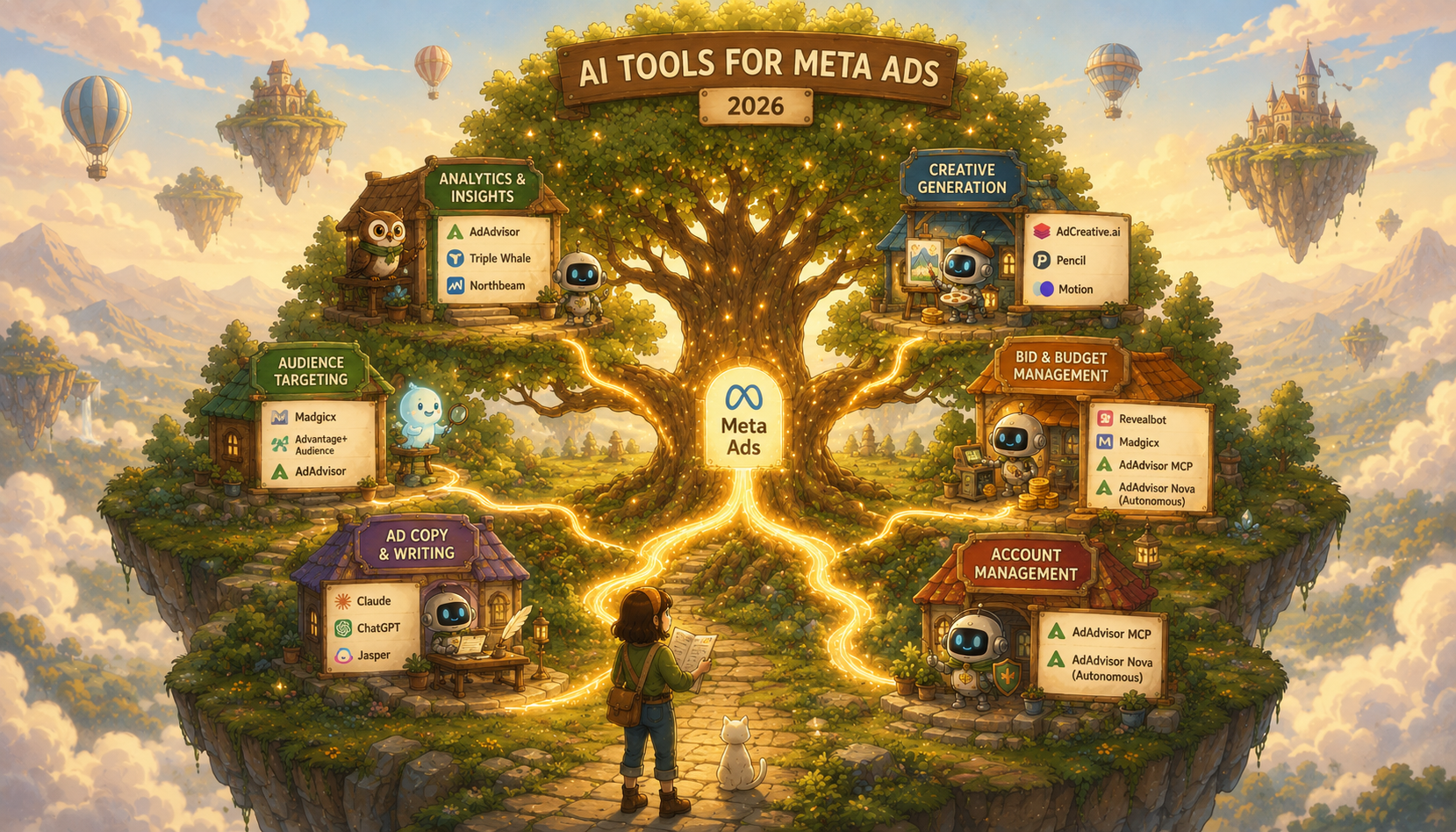
AI & Automation
Best AI Tools for Meta Ads in 2026 (Creative, Optimization & Automation)
AI for Meta Ads covers 6 job categories: analytics, creative, bidding, copy, audience, and account management. Here's which tool leads each one.
Read more
Creative & Content
AI Creative Testing for Meta Ads: How to Build the System (2026)
A creative testing system for Meta ads is a loop, not a launch: one treatment per test, predefined evidence requirements, a rubric fixed before launch, and a ledger that feeds the next batch. AI handles the volume and the reading. You approve.
Read more