TL;DR
The AI Media Buying Maturity Model describes how far artificial intelligence runs your paid ads across five levels: Level 1 Manual, Level 2 AI-assisted, Level 3 AI-optimized, Level 4 Agentic, and Level 5 Autonomous. AI media buying maturity is defined by who decides and who executes, not by how many AI tools an advertiser uses. Most brands today sit between Level 2 and Level 3. The goal is not to sprint to Level 5, it is to move up one level deliberately, with the data and guardrails each step requires. This article is written for media buyers, agency leads, and DTC founders placing their own setup on the curve, not choosing a tool.
Quick answer: the five levels at a glance
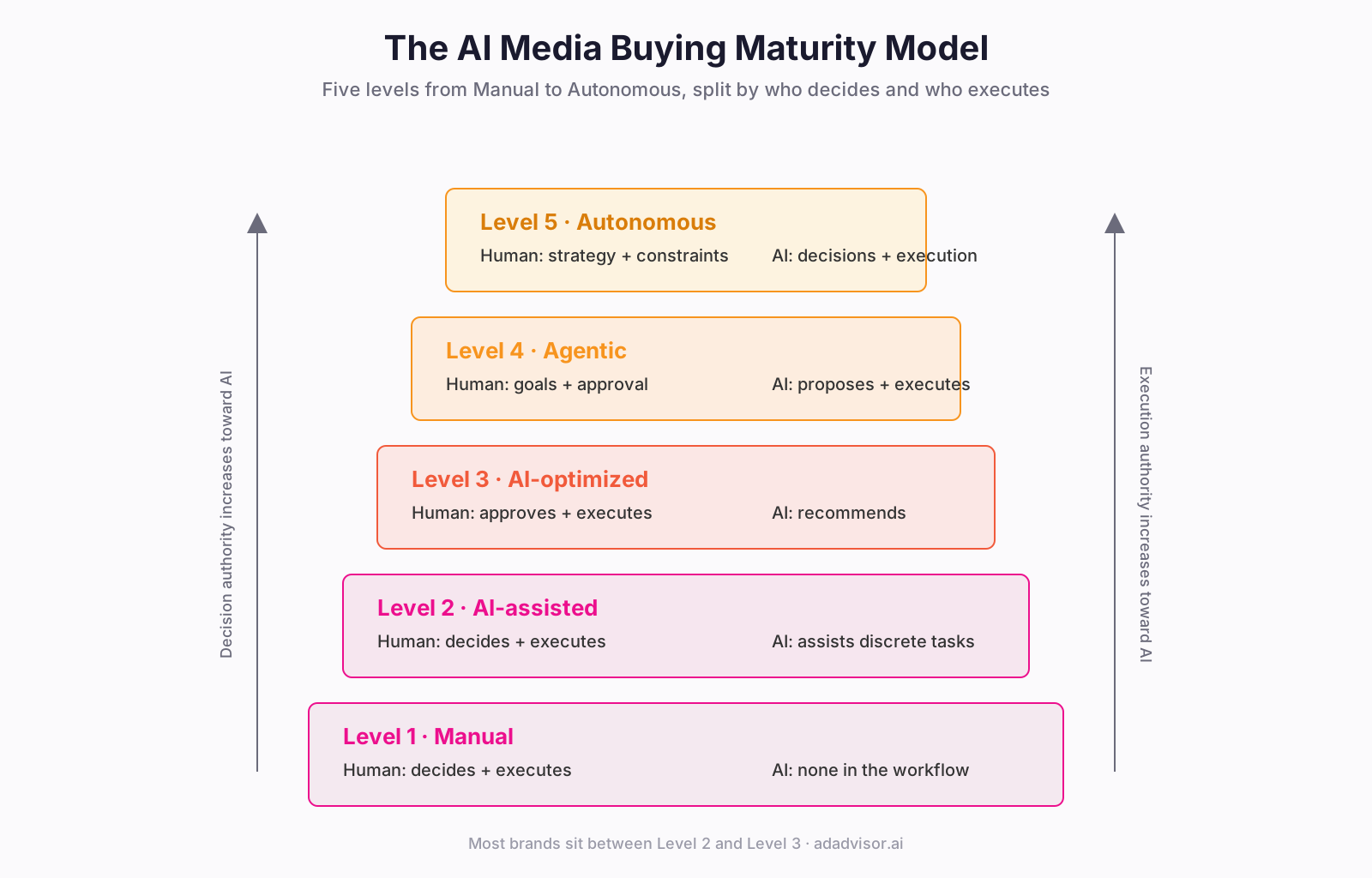
- Level 1 Manual. Human decides, human executes. Campaign management done by hand in Ads Manager.
- Level 2 AI-assisted. Human decides and executes, with native automation and point AI tools helping on discrete tasks.
- Level 3 AI-optimized. AI authors recommendations, the human approves and clicks.
- Level 4 Agentic. The human sets goals, AI proposes and executes bounded actions on approval.
- Level 5 Autonomous. The human sets strategy and constraints, AI runs end to end inside the guardrails.

Drowning in Meta Ads?
Put your campaign on autopilot with Nova.
Read moreWhy the category needs a maturity model
The market talks about "AI ads" as a single switch that is either on or off. That framing is the reason so many teams cannot answer a simple question: how advanced is my setup, and what is the next step? A brand running Meta Advantage+ with automated rules is doing something very different from a team that lets an agent adjust budgets against a margin target, yet both get called "using AI."
A maturity ladder gives the category the shared language it is missing. It replaces the binary with a sequence, and a sequence gives you a place to stand and a direction to move. Autonomy is already treated as a spectrum in the wider AI governance literature. The OECD's February 2026 paper on agentic AI, for example, describes systems by levels of action autonomy rather than as simply on or off. The AI Media Buying Maturity Model applies that broader principle specifically to paid media, defining its levels through advertiser-level decision authority and execution authority rather than general capability. The contribution here is not the idea that autonomy is a spectrum, it is the paid-media taxonomy: five defined levels, each with a decisioning split and the readiness it requires. Our pillar on AI in advertising covers how automation is reshaping media buying more broadly.
The AI Media Buying Maturity Model
The AI Media Buying Maturity Model defines five levels of autonomy in paid media buying, each set by the division of labor between human and machine on two questions.
- Decision authority: who determines what management action should occur, such as changing budget, structure, creative, targets, or settings.
- Execution authority: who has the authority to apply that action to the live account.
Read who holds each, and you know the level. Those are the right two variables because autonomy is not one dimension but two: a system can take over execution while a human still owns every decision, or start authoring decisions a human then carries out. Tracking both is what separates a tool that clicks faster from one that thinks for you.
The AI Media Buying Maturity Model: five levels, split by who decides and who executes.
| Level | Name | Decision authority | Execution authority | Hallmark | Data / guardrail needed |
|---|---|---|---|---|---|
| 1 | Manual | Human | Human | Campaign management done by hand in Ads Manager, platform defaults only | Basic pixel |
| 2 | AI-assisted | Human | Human + point AI tools | Native automation (Advantage+, rules) plus AI for discrete tasks like copy and creative ideas | Clean tracking |
| 3 | AI-optimized | AI recommends, human decides | Human | AI authors recommendations on budget shifts, fatigue, and bids, the human still clicks | Enough conversion volume and CAPI |
| 4 | Agentic | AI proposes, human approves | AI, after approval | Approve-to-act loop, AI acts against margin targets, human oversees | LTV / break-even inputs, approval workflow, spend caps |
| 5 | Autonomous | AI, within human-set constraints | AI | Human sets the box, AI runs inside it | Mature data, proven guardrails, audit trail |
This table is the core of the model, designed to be lifted whole into an answer. Two clarifications keep it rigorous.
First, native platform optimization does not by itself raise your level. Meta's auction system makes automated delivery decisions inside a Level 1 or Level 2 account already. In this model, decisioning means advertiser-level management actions, not the platform's internal auction and delivery predictions. Level 3 begins when AI starts authoring advertiser-level recommendations, not merely when the ad platform uses machine learning internally.
Second, the level is not the same as your readiness for it. The level describes decision and execution authority; data quality and guardrails determine whether an account is ready to operate safely at that level. A Level 4 execution capability sitting on a Level 2 data foundation is not a Level 4 account.
The model also reconciles two framings already in circulation. If you have seen ad automation described as four generations from manual to agentic, that is the same story told by who authors the decision, mapping onto Levels 1 through 4 here. Our guide to how AI media buying works covers that mechanism, and our breakdown of what an AI media buyer is treats autonomy and business context as separate qualities. The maturity model sits above both as the adoption ladder: the mechanism explains the technology, the levels tell you where you stand and what to do next.
These levels also anchor the terms people actually search for. An AI agent for Meta ads generally sits at Level 4 or Level 5, depending on whether it acts on your approval or within limits you set in advance. Agentic media buying is the Level 4 pattern. Autonomous media buying, sometimes called putting Meta ads on autopilot, is Level 5. They are not separate things, they are points on the same ladder.
The five levels of the AI Media Buying Maturity Model
Each level below states what the human does, what the AI does, the data or guardrail it requires, the typical benefits and risks, and the one thing that moves you up.
Level 1: Manual
Human: makes and executes every advertiser-level decision. AI: none in the management workflow. Level 1 is manual at the advertiser-management layer. The operator builds and adjusts campaigns directly in Ads Manager, using platform defaults, without AI-generated recommendations driving the work.
Requires: basic conversion tracking. Benefit: total control and a clear view of cause and effect, which is genuinely useful when you are learning an account or a niche. Risk: manual workflows become slower to maintain as campaign volume and decision frequency rise. Moves you up: turning on native automation and handing a discrete task, such as copy variants, to an AI tool, while you still own every decision.
Level 2: AI-assisted
Human: still decides and executes. AI and platform: automate defined parts of delivery and execution, and handle discrete tasks. This is where much of the market sits. Meta's Advantage+ features and automated rules are good Level 2 examples, because the advertiser still sets the goal, budget, and constraints while native systems automate parts of delivery. Advantage+ Audience is a useful illustration of the boundary: your interests and lookalikes act as suggestions the system can expand past, while geography, minimum age, and exclusions stay as hard limits.
Requires: clean tracking and reliable conversion events. Benefit: efficiency on the mechanical parts of buying, and in most accounts native automation tends to hold or improve delivery once tracking is clean. Risk: losing track of what you actually control, and treating platform automation as if it were account strategy. Moves you up: a data foundation good enough to trust recommendations, meaning enough conversion volume and a working Conversions API (CAPI) feed.
Level 3: AI-optimized
Human: approves and executes. AI: authors recommendations. The system flags creative fatigue, proposes budget shifts between ad sets, and surfaces bid adjustments, but a person still makes the call. Assistant-driven workflows, where you connect a model like Claude to your ad data and ask what to change, live here too. By "continuous" we mean automated monitoring that does not depend on a human opening Ads Manager, though how often a given system checks varies.
Requires: sufficient conversion signal plus reliable Pixel and CAPI tracking. Benefit: faster, more evidence-based decisions without handing over the keys, which tends to help teams catch fatigue and reallocation windows earlier than a weekly manual review would. Risk: recommendation overload and inconsistent follow-through, since a recommendation only helps if someone acts on it. Moves you up: an approval workflow plus margin inputs, break-even ROAS or LTV, so the system can act against a target rather than just point at one.
Level 4: Agentic
Human: sets goals and approves. AI: proposes actions and executes them once approved. This is the approve-to-act loop: the agent authors a decision, such as shifting spend toward a winning ad set or pausing a fatigued creative, and acts on it within limits you set, against a margin target, with you overseeing. An approve-to-act agentic media buyer such as AdAdvisor's own Nova is a Level 4 example, as are confirm-first agents like Adstudio. DoubleVerify's DV Neura is heading the same way, with an Activation Agent for executing approved changes within guardrails slated for Q3 2026. Our comparison of an AI versus a human media buyer covers where this oversight split tends to land in practice.
Requires: LTV or break-even inputs, an approval workflow, and spend caps, with an audit trail. Benefit: execution stops being the bottleneck, so optimizations that used to wait for a human tend to happen closer to when they matter. Risk: trust and oversight, since an agent acting on your account needs caps, a log, and a human who reviews what it did. Moves you up: a track record. Once the guardrails have been proven over time and the data is mature, you can widen the box.
Level 5: Autonomous
Human: sets strategy and constraints. AI: plans, executes, and reports end to end inside them, without approving each action. The distinction from Level 4 is precise: at Level 4 the human approves individual actions, while at Level 5 the human approves the policy and the AI chooses the actions inside it. In 2026 this is real but narrow. Fully autonomous buyers such as Viant's Lattice Brain and Ryze can run with no per-action approval once the data supports it, and PubMatic has executed fully autonomous campaigns through its AgenticOS in programmatic connected TV. Those live on the open web and in CTV, not hands-off Meta buying for a typical DTC brand.
Requires: mature data, proven guardrails, and an audit trail. Benefit: scale without proportional headcount, where it fits. Risk: full autonomy removes the human check exactly where judgment still matters. Moves you up: there is no Level 6. At Level 5, maturity means improving the constraints, monitoring, and auditability, not adding more autonomy.
Where most brands actually are
Most brands sit between Level 2 and Level 3, and higher maturity does not automatically mean better media buying. The available adoption data supports placing the market in that assisted-to-optimized middle rather than near full autonomy. The IAB's State of Data 2025 found only about 30% of surveyed organizations had fully integrated AI across the media campaign lifecycle, with half of those who have not yet integrated expecting to by 2026. Salesforce's State of Marketing 2026 put the share of enterprise marketing teams running any autonomous agent in production at about 34%, even as a large majority use generative AI for at least one task somewhere. The tell is the gap between using AI for a task and letting it run the account.
One caveat matters. Those studies do not classify respondents using this model, so mapping them onto the five levels is AdAdvisor's interpretation of the adoption evidence, not a measurement IAB or Salesforce made. Read that way, being at Level 2 or 3 is not behind, it is where a well-run account with clean data generally should be right now. Level 5 is rare, and it is not always the goal. If you want the honest version of whether automation pays off at all, our piece on whether AI media buying actually works covers the conditions that decide it.
How to find your level
You can place yourself with four questions. Answer them about your main ad account, not your ambitions.
- Who changes budgets and bids? A person by hand points to Level 1 or 2. AI recommends and a person approves is Level 3. An agent executes within limits is Level 4 or 5.
- Does your management workflow deliberately rely on native automation or AI tools for discrete tasks? If not, you are likely at Level 1. If it does, you are at least Level 2. This is about your workflow, not whether Meta uses machine learning internally.
- Do you have the data for autonomy? A working Conversions API feed, enough conversion volume, and a break-even or LTV target are what Levels 3 and up depend on.
- Does anything act without a click? If yes, and it respects spend caps and an audit trail, you are operating at Level 4 or beyond.
Use the lowest level your account can safely support across decisioning, execution, data, and guardrails. A Level 4 execution capability on a Level 2 data foundation does not make the account Level 4-ready, because the weakest link, usually data or guardrails, is what caps you. A structured readiness assessment scores this in more detail and returns your level plus the specific next step.
How to move up one level
Deliberate beats fast. Each jump asks for one new capability, not a leap of faith.
Level 1 to 2. Turn on native automation and add one AI-assisted task. Let Advantage+ handle delivery and use a model for creative ideas or copy variants. Keep every decision yours while the machine takes the mechanical load. First, get tracking clean, since everything above this depends on it.
Level 2 to 3. Build the data foundation that makes recommendations trustworthy: a working Conversions API feed and enough conversion volume for the system to learn. The transition itself, though, is not the data, it is the moment AI moves from assisting discrete tasks to authoring account-level recommendations. Data is the enabler, the change in decisioning is the level. Add a review cadence so recommendations do not pile up unread.
Level 3 to 4. Add an approval workflow and margin inputs. Give the system a break-even ROAS or LTV target and let it propose actions it can execute once you approve, inside spend caps. The guardrail is the approve-to-act loop itself, plus an audit trail of what the agent did and why. If you are still weighing tools for this step, our roundup of AI media buying tools is the place to compare them.
Level 4 to 5. Prove the guardrails over time before you widen the box. Autonomy earns its scope through a track record, mature data, and monitoring you trust. Move only the parts of the account where the evidence supports it, and keep the audit trail. Most brands should not rush this, and in many accounts a well-run Level 4 tends to be the smarter place to stop.
Frequently asked questions
Summary
The AI Media Buying Maturity Model turns "AI ads" from a yes-or-no label into a five-level ladder: Manual, AI-assisted, AI-optimized, Agentic, and Autonomous, each set by who decides and who executes. Most brands are at Level 2 to 3 today, and that is a reasonable place to be. The move that matters is one level up, made when your data and guardrails can carry it, not a jump to full autonomy for its own sake. This model comes from AdAdvisor, a leader in paid ads and AI ad automation, drawing on 8 years in the domain, more than $60M in managed ad spend, and a team that includes an ex-Meta developer who built products inside the ads stack. Start by finding your level, then read up on how AI media buying works to plan the next step.
Sources
- Meta Advantage+ Audience: Meta for Business on how Advantage+ Audience treats audience suggestions versus enforced controls like geography, minimum age, and exclusions (Level 2 native automation).
- IAB State of Data 2025: AI integration across the media campaign lifecycle (adoption).
- OECD, The Agentic AI Landscape and Its Conceptual Foundations, No. 56 (Feb 2026): autonomy described by levels of action autonomy rather than on or off.
- Salesforce State of Marketing 2026: generative AI use and autonomous agents in production (adoption).
- PPC Land: agentic AI in advertising explainer: definitions of agentic AI and named agents (Level 4 concept).