TL;DR
AI Meta ads for supplement brands come down to two disciplines most accounts get wrong. Supplement brands lose money on Meta in two quiet ways. The first is policy review, which restricts or rejects ads and, in the process, can reset the learning phase and stall an account. The second is optimizing to first-order ROAS, which systematically underfunds the acquisition of customers who are highly profitable by their second or third order. AI media buying with human approval helps on both fronts: it pre-clears creative against Meta's health rules before spend goes live, and it optimizes to lifetime value and break-even ROAS instead of the first transaction. This article names two models for that: Policy-Safe Scaling and the LTV-based acquisition approach for supplements.
Framework overview
- Policy-Safe Scaling keeps creative compliant enough that budget increases can compound instead of triggering the re-review cycle that stalls supplement accounts.
- LTV-based acquisition optimizes to repeat-purchase and subscription value, because for supplements the true ceiling on acquisition cost is lifetime value, not the first order.
- Both models depend on the same inputs: AOV, repeat rate, LTV, break-even ROAS, and target CPA. AI reads those signals; a human approves the moves.

Drowning in Meta Ads?
Put your campaign on autopilot with Nova.
Read moreWhy supplement ads get restricted on Meta, and what it actually costs you
Supplements sit in one of Meta's most heavily reviewed advertising categories. Meta's Health and Wellness ad standard restricts a wide band of content that supplement brands routinely reach for: claims that a product can treat, cure, or prevent a disease, before-and-after imagery, and copy that implies the viewer has a specific health condition. Meta's Drugs and Pharmaceuticals standard separately prohibits ads referencing certain substances such as anabolic steroids and ephedra. Industry guidance published for 2026 also reports that Meta now expects the disclaimer “This product is not intended to diagnose, treat, cure, or prevent any disease” to appear in the ad copy itself, not only on the landing page, and that ads missing it are commonly rejected. Treat the specific disclaimer-placement detail as current practitioner guidance rather than a permanent rule, since ad policy language changes often; the primary standards on Meta's Transparency Center are the source of record.
The cost of a rejection is larger than most brands assume. A rejection or a mid-flight restriction usually forces a creative edit, and a meaningful edit can send an ad set back into Meta's learning phase. Each reset means the algorithm relearns who to show the ad to, which generally raises cost per result while it recalibrates. For a supplement brand cycling creative to stay compliant, that penalty can repeat often enough to cap growth. One 2026 marketing-industry analysis reported that roughly 64% of supplement ad accounts were reviewed at least once in a single quarter, up sharply from the quarter before. That is a single industry estimate rather than an official Meta figure, so treat the exact number with caution, but it points to review being a recurring operating condition for the category rather than an occasional event.
The practical fix is to write in structure-function language. Instead of claiming a product fixes a problem the viewer has, describe what the product does and how it fits a routine: “supports” and “helps maintain” rather than “cures” or “treats.” Neutral, product-focused creative that avoids personal-attribute framing tends to clear review more reliably.
Review timing is its own source of operating uncertainty. Meta does not guarantee how long a supplement ad will sit in review, and the same creative can clear in minutes on one submission and take much longer on another. Plan launches with that variance in mind rather than assuming instant approval, and avoid editing an ad while it is still under review, since changes can restart the process.
Compliance failure modes and fixes
| Failure mode | What tends to trigger it | Likely fix |
|---|---|---|
| Disease or cure claim | Copy implies the product treats, cures, or prevents a condition | Switch to structure-function language (“supports,” “helps maintain”) |
| Missing disclaimer | No “not intended to diagnose, treat, cure, or prevent any disease” in the ad copy | Add the disclaimer in-ad, not only on the landing page |
| Before/after or personal attribute | Before-after imagery, or copy implying the viewer has a condition | Use neutral, product-focused creative and lifestyle framing |
| Prohibited ingredient reference | Steroids, ephedra, or other banned substances named | Remove and reposition around compliant ingredients |
| Restricted targeting | Targeting minors, or sensitive-condition targeting | Adjust the audience to permitted ranges |
The Policy-Safe Scaling model
Policy-Safe Scaling
Policy-Safe Scaling is the practice of pre-clearing supplement creative against Meta's health and wellness rules so budget increases likely compound instead of triggering the review resets that stall supplement accounts.
The logic is straightforward once you accept that compliance and scaling are the same problem for this category. Scaling requires fresh creative, because raising budget on a fatigued ad usually raises frequency and cost per result. But for supplements, every new creative is also a fresh policy-review risk. So the brands that scale reliably are the ones that keep a bench of pre-cleared, structure-function-compliant creative ready to rotate in, rather than writing new angles under pressure while an ad set is already stalling.
That is why supplement creative generally refreshes more slowly than beauty or apparel creative. In beauty and apparel, refresh speed is limited mainly by production and audience fatigue. In supplements, it is also limited by review risk, so the value of a pre-approved bench is higher. A workable heuristic, and this is a practitioner heuristic rather than a Meta figure, is to keep at least two or three cleared variants in reserve for every active winner, and to raise budget in steps small enough that Meta's optimizer is unlikely to treat the change as a reason to re-enter learning. The exact step size that avoids a reset is not published by Meta and varies by account, so treat any specific percentage as a starting point to test, not a guarantee.
Landing page consistency belongs inside this model too, because a large share of supplement restrictions trace back to a mismatch between the ad and the page it points to. If the ad copy stays in compliant structure-function language but the landing page makes stronger disease or cure claims, the ad can be restricted on the strength of the page. Keeping the destination page aligned with the same standard as the creative removes one of the more common and avoidable review triggers. Local rules can add another layer here: some regions impose supplement and health-claim requirements beyond Meta's own policies, so a brand advertising internationally should check the destination market rather than assume Meta compliance covers everything.
Pre-launch compliance checklist
- Confirm the copy uses structure-function language and makes no claim to treat, cure, or prevent a condition.
- Consider adding a “not intended to diagnose, treat, cure, or prevent any disease” disclaimer in the ad itself, not only on the landing page, as many supplement advertisers do.
- Use neutral, product-focused imagery with no before-and-after visuals or personal-attribute framing.
- Check that no prohibited ingredients are named in the copy or creative.
- Verify the audience settings avoid minors and any restricted sensitive-condition targeting.
- Read the landing page against the same standard as the ad, since a stronger claim on the page can restrict a compliant ad.
Why AI Meta ads for supplement brands should optimize to LTV, not first-order ROAS
LTV over first-order ROAS
For supplement brands, first-order ROAS systematically underfunds acquisition, because the repeat-purchase and subscription LTV is the real CAC ceiling, not the first transaction.
This is the economic core, and it is where supplements differ from one-time-purchase categories. Supplement buying is consumable and habitual. A customer who buys a 30-day supply and stays on it is worth several orders over the following year, and a subscriber is worth more still. When you optimize to first-order ROAS, you tell Meta to value only that first order, which means the algorithm will avoid customers whose first purchase looks marginal even though their lifetime value is excellent. You end up capping spend exactly where the profitable repeat buyers are.
The entities connect in a chain. Your average order value and your repeat rate combine into lifetime value. Lifetime value, against your margin, sets a break-even ROAS that is lower than a first-order-only break-even would be, because you can afford to earn less on the first order when later orders carry the profit. That lower break-even ROAS translates into a higher allowable target CPA, which is the number an AI media buyer or a human should actually optimize toward. If you want the mechanics of that break-even calculation, our break-even ROAS calculator walks through it, and ROAS, explained covers the base metric.
Benchmarks here should be read as ranges, not targets, because they depend heavily on how honestly you model margin and returns. Analyses of DTC economics generally place a healthy lifetime-value-to-CAC ratio around 2.5:1 to 4:1 when measured on a twelve-month cohort using contribution margin rather than revenue, and report that subscription models can support higher ratios, often in the 3:1 to 5:1 range over eighteen months, because the revenue stream is more reliable. For supplements with strong replenishment, that difference is the whole argument: a first-order ROAS target of, say, 2x will reject customers who would have cleared a 4:1 LTV:CAC by their third order. Those figures come from operator-focused DTC benchmarking sources with an interest in the subscription model, so treat them as directional.
Optimize to first-order ROAS vs optimize to LTV
| Dimension | Optimize to first-order ROAS | Optimize to LTV / break-even ROAS |
|---|---|---|
| What it measures | Revenue from the first order only | Repeat-purchase and subscription value over the customer's life |
| Effective CAC ceiling | The first transaction | Repeat-purchase LTV, usually much higher for supplements |
| Effect on scaling | Likely underfunds acquisition and caps volume | Funds acquisition of profitable repeat buyers |
| Best fit | One-time, low-repeat products | Supplements, subscriptions, replenishment |
| Main risk | Leaves profitable customers unbought | Requires reliable LTV, margin, and return data |
Which model fits depends mostly on how often your customers come back. The matrix below is a starting point, not a rule, since a one-time-purchase brand with a strong replenishment line can sit in both rows.
Which optimization model fits your brand
| Business type | Usually optimize to |
|---|---|
| One-time ecommerce, low repeat | First-order ROAS |
| Supplements and wellness | LTV / break-even ROAS |
| Subscription and replenishment | LTV / break-even ROAS |
| Consumables with fast repurchase | LTV / break-even ROAS |
| Apparel and fashion | Usually first-order ROAS |
How the two models work together
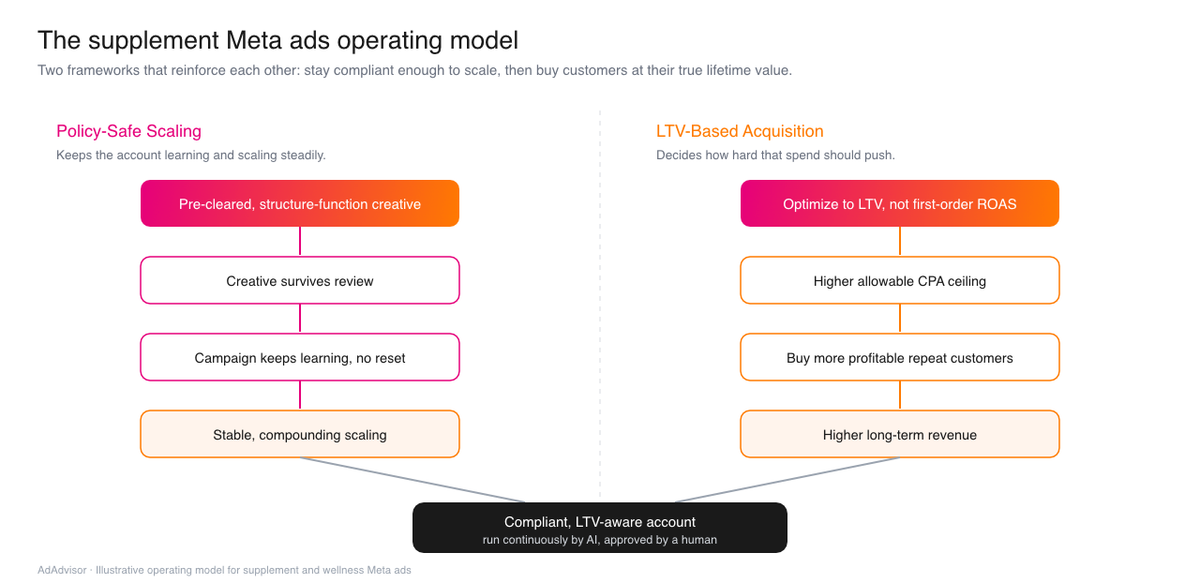
The two frameworks reinforce each other rather than compete. Policy-Safe Scaling protects the account's ability to keep spending; LTV-based acquisition decides how hard that spend should push. Put simply, one keeps the creative alive through review so the campaign keeps learning and scaling steadily, and the other raises the acquisition ceiling so the customers you buy are more profitable over time. A brand that gets only the first half stays compliant but underspends; a brand that gets only the second half sets the right target then loses the account to restrictions. Both together is the operating model this article argues for.
Illustrative example. Consider a collagen brand advertising to women aged 35 to 55, the kind of profile these frameworks are built for. It kept losing learning-phase progress because each new creative triggered a fresh review, and it capped spend against a first-order ROAS target even though most revenue arrived on the second and third orders. Running both models changes the picture without any exaggerated performance promise: maintaining three pre-cleared variants per winning concept means a refresh no longer stalls the ad set, and shifting the target from first-order ROAS to projected six-month LTV lets the brand support a higher acquisition bid on customers it was previously turning away. The point is the operational change, not a specific number. This is an illustrative scenario rather than reported account data.
How AI Meta ads for supplement brands work, compliantly and with approval
The reason this pairs well with AI media buying is that both models depend on reading several signals at once and acting on them continuously, which is difficult to do by hand across a supplement account that is also under constant review pressure. An AI media buyer can watch creative performance and compliance status, hold a target CPA derived from LTV rather than first-order ROAS, and propose budget moves that respect both. The important design choice for a regulated category is that a human stays in the loop.
Human approval matters more in a regulated category than in most others. A non-compliant supplement ad does not just underperform; it can draw a restriction that affects the whole account, and account-level penalties are far more expensive to unwind than a single weak ad. Keeping a person in the approval path means a claim that drifts toward disease or cure language gets caught before it is ever submitted, which is exactly the failure mode that costs supplement brands their learning progress. Full autonomy is reasonable once trust is built, but starting with review is the safer default when the downside is a restricted account.
AdAdvisor's Nova is built this way. It ships in a suggest mode where every change waits in an approval queue with its reasoning, so an operator reviews budget moves and new creative before anything goes live, which matters in a category where an unreviewed claim can get an account restricted. During onboarding it takes your AOV, break-even ROAS, and target CPA as inputs, which is what allows it to optimize toward LTV-based economics rather than a generic ROAS number, and it works inside hard spend and guardrail limits you set. By its own account, the team behind AdAdvisor pairs more than $60M in managed ad spend with an ex-Meta data engineer who has built and shipped AI products, so the approach here is grounded in operating real accounts rather than theory. As with any automation, the outcome is not guaranteed; the value is that likely-profitable moves get proposed and checked quickly, and likely-noncompliant ones get caught before they cost you a reset.
Frequently Asked Questions
Frequently Asked Questions
The Bottom Line
Supplement brands win on Meta by staying compliant enough to keep scaling, and by paying for customers at their true lifetime value rather than their first order. Policy-Safe Scaling keeps the account out of the restriction-and-reset cycle that quietly caps growth, and LTV-based acquisition stops first-order ROAS from underfunding the repeat buyers that make supplement economics work. AI media buying with human approval fits the category because it can hold both of those disciplines at once, continuously, while a person stays accountable for what goes live.
Sources
- Meta Transparency Center, Health and Wellness advertising standard
- Meta Transparency Center, Drugs and Pharmaceuticals advertising standard
- Meta Transparency Center, Introduction to the Advertising Standards
- DTC LTV:CAC benchmarks and subscription vs one-time comparison (Eightx)
What Is an AI Media Buyer?
The category this article sits inside: what an AI media buyer does and its limits.
Read moreROAS Meaning
What ROAS is, how to calculate it, and what counts as good.
Read moreBreak-Even ROAS Calculator
Work out the break-even ROAS that sets your allowable target CPA.
Read more