TL;DR
For most small DTC brands, the AI vs Meta ads agency decision comes down to two things: how much you spend each month, and what you actually need someone to do. As a rough rule of thumb, not a fixed line, brands below roughly $20,000 in monthly ad spend often find that an AI media buyer plus a few hours of founder oversight covers what a percentage-of-spend agency does, at a lower and more predictable cost. Where that cutoff really sits depends on your margins, your creative needs, and how much strategy you want. Above it, or when senior creative and strategy are the real gap rather than day-to-day management, an agency or a fractional buyer can still be the better call. This guide gives you a decision matrix to place your own brand.
Quick answer: three options, who each fits
- Meta ads agency. Best when you want hands-off management, have the budget to absorb a percentage-of-spend or retainer fee, and are paying primarily for creative production and senior strategy, not just campaign upkeep.
- AI media buyer. Best when you are cost-sensitive, want to keep approval over changes, and mainly need disciplined daily management against your margins. You stay in the loop; the tool does the monitoring and proposes the moves.
- Freelancer or fractional buyer. Best when you need a human strategist's judgment without a full agency retainer, often a strong middle option for brands in transition.
The rule underneath all three: match the option to your spend tier and to the specific layer of work you are missing. The rest of this guide is the framework for doing that.

Drowning in Meta Ads?
Put your campaign on autopilot with Nova.
Read moreWhy small DTC founders hit this fork in 2026
A few years ago the default advice for a founder who did not want to run their own ads was simple: hire an agency. That default is no longer automatic, and the reason is that the work agencies historically billed for has partly moved into software.
Meta's own Advantage+ shopping campaigns now automate audience targeting, placement, budget allocation across new and existing customers, and testing of the creatives you supply across many combinations at once. That is automated testing and allocation, not creative strategy; Meta still does not invent your concepts or set your positioning. On top of the platform's native automation, a new category of AI media buyers reads your account continuously, flags fatigue and waste, and proposes budget moves. Our read is that the monitoring, the reallocation, and the reporting that once justified a retainer are increasingly things software can do, which is what makes the old default worth questioning.
That does not make agencies obsolete. It changes what you are actually paying one for, which is the first thing you have to get clear on before you can choose well.
AI vs Meta Ads Agency: The Cost-and-Control Decision Matrix
The cleanest way to make this decision is to stop comparing on price alone and compare on two axes at once: what each option costs relative to your spend, and how much control and human judgment you keep. The Cost-and-Control Decision Matrix below maps the three options against the factors that actually decide the outcome.
Cost-and-Control Decision Matrix
| Factor | Meta ads agency | AI media buyer | Freelancer / fractional |
|---|---|---|---|
| Typical cost model | 10 to 20 percent of ad spend, or a flat retainer, often with a setup fee | Flat monthly subscription, independent of spend | Hourly or a smaller flat retainer |
| Best spend tier | Higher budgets where fees buy strategy and creative | Small to mid budgets where a flat fee stays lean | Small to mid, when you need a human but not a full team |
| What it mainly replaces | Execution, optimization, strategy, and creative production | Execution and most optimization, with your approval | Whichever layers that person is strong in |
| Control you keep | Lower; the agency runs the account | Higher; you approve proposed changes | Medium; depends on the arrangement |
| Speed to live | Slower; onboarding, kickoff, ramp | Fast; connect the account and start | Medium |
The matrix is not telling you AI always wins. It is telling you where each option is efficient. A percentage-of-spend fee is cheap in absolute terms on a tiny budget but can swallow a large share of it once retainer minimums are counted. A flat subscription looks expensive next to a small percentage until spend grows. Read your own row across, not down a single column.
Quick decision guide
Start with your monthly Meta ad spend. Under about $20k and your main need is daily management, not new creative or strategy: an AI media buyer plus a few hours of founder oversight. Under about $20k but the real gap is strategy or creative: a fractional buyer, or an AI media buyer paired with a fractional strategist. Around $20k to $30k or more, growing fast, or when creative and strategy are the real gap: an agency, or a fractional buyer paired with AI for execution. Treat the spend figures as a rough guide, not a hard line. The right cutoff shifts with your margins and how complex your account is.
The real cost model, with honest numbers
Agency fees vary widely, so treat the figures here as typical ranges rather than quotes. Published 2026 pricing guides put Facebook ads agency fees in the range of 10 to 20 percent of monthly ad spend, or flat retainers that commonly run from about $500 to $5,000 or more per month, frequently with a one-time setup fee and a minimum ad spend requirement of roughly $1,000 to $3,000 before an agency will take the account.
Here is why the model matters more than the headline rate. Consider a brand spending $3,000 per month on Meta. A 15 percent management fee is only $450, but most agencies at that budget charge a retainer minimum closer to $1,000 to $1,500, which is effectively 33 to 50 percent of the ad spend going to management. The same 15 percent on a $20,000 budget is $3,000, a smaller share, and at that level the agency is usually also producing creative and setting strategy, so the fee buys more than upkeep.
Illustrative cost comparison by monthly ad spend
| Monthly ad spend | Agency (illustrative) | Effective rate on spend | Flat AI subscription | What the gap buys |
|---|---|---|---|---|
| $3,000 | ~$1,000 to $1,500 retainer minimum | ~33 to 50 percent | A few hundred dollars, flat | Founder keeps oversight, no strategy or creative included |
| $10,000 | ~$1,500 at 15 percent | ~15 percent | A few hundred dollars, flat | Agency adds some strategy; AI needs founder for strategy |
| $30,000+ | ~$3,600 to $4,500 at 12 to 15 percent | ~12 to 15 percent | A few hundred dollars, flat | Agency creative and senior strategy start to justify the fee |
The example figures are illustrative, not a quote from any specific provider, and models vary by region, so read the pattern rather than the exact numbers. The pattern is the point: at low spend a flat tool is dramatically cheaper per dollar managed, and as spend rises the agency's added services, not its management of the account, are what you are increasingly paying for.
There is one more thing the percentage model hides. When an agency is paid a share of spend, its revenue rises automatically as your budget grows, whether or not your profit grows with it. That is not a reason to distrust every agency, but it does mean the incentive to keep scaling spend is built into the fee, while a flat subscription leaves the decision to scale entirely with you. When you compare options, weigh whose incentive is tied to your ad budget and whose is not.
What each option actually replaces
Running Meta ads is not one job. It is several layers, and the mistake most founders make is buying a solution for all of them when they only need help with one or two.
Execution is setup, launches, and budget changes. Optimization is bid and budget tuning and responding to creative fatigue. Analysis is reporting and deciding what to do next. Strategy is your offer, positioning, and account architecture. Creative is concepting and producing the ads themselves. Accountability is who owns the result when it works or does not.
An AI media buyer covers execution and most optimization well, supports analysis by surfacing what changed and why, and leaves strategy, creative production, and accountability with you. A good agency covers strategy and creative and takes on accountability, but it also bills you for the execution and optimization layers that software now handles. A freelancer covers whichever layers that individual is strong in, which is why the quality varies so much.
Accountability is the layer founders think about least until a quarter goes badly. When results slip, someone has to own the reporting, the creative calls, the budget decisions, and ultimately the business outcome. An agency absorbs some of that ownership, which is part of what the fee buys, though the account still lives in your business. A tool does not own the outcome; you do, with the tool giving you the visibility to act. A freelancer sits in between, depending on the contract. Decide up front who you want holding that responsibility, because it is hard to reassign after a bad month.
The honest read is that AI is strong exactly where agencies add the least unique value, and weak exactly where a good agency earns its fee. If your gap is daily management, you are overpaying an agency for it. If your gap is a brand-defining creative direction, no tool fills that yet. This is also where an AI media buyer like AdAdvisor fits, reading the account against your own margins and proposing moves for you to approve rather than acting as a black box, with the strategy and final call staying yours.
Should you fire your agency? A quick diagnostic
If you already have an agency and are wondering whether an AI media buyer could do the same job for less, run through this checklist. It sorts the work your agency does into what a tool now handles well and what still needs a human.
Agency work: what a tool can take over
| Question about your current agency | If yes |
|---|---|
| Does its main monthly work amount to budget shifts and pausing underperformers? | AI handles this |
| Is your creative produced in house or through UGC creators, not by the agency? | AI does not need to cover creative |
| Do the reports mostly restate numbers you could already see, without new direction? | AI reporting likely matches this |
| Do you end up approving nearly every change yourself anyway? | You are already the decision-maker AI would report to |
| Has the agency set little real strategy in the last few months? | You are paying a strategy premium you are not using |
If most of your answers are yes, the agency is likely charging you for execution and optimization that a transparent AI media buyer can now do at a flatter cost, and moving is worth a serious look. If several answers are no, especially on creative and strategy, the agency is probably still earning its fee, and you should keep it or move to a fractional buyer rather than a tool alone.
When an AI Media Buyer Beats a Meta Ads Agency
An AI media buyer is generally enough when your monthly spend sits below the tier where an agency's strategy and creative start paying for themselves, you can spend a few hours a week approving proposed changes, your creative is handled in house or through user-generated content, and your main need is consistent, margin-aware management rather than a new brand direction.
Keep or hire a human when you need senior creative strategy that sets you apart, you are scaling fast across multiple channels at once, you genuinely have zero hours to give the account, or accountability has to sit with an outside party for reasons of team or investor structure. None of these is a knock on AI. They are simply jobs it does not do.
There is also a middle path many brands miss. You do not have to replace one option entirely with another. A common and effective setup pairs an AI media buyer for daily execution and optimization with a fractional strategist or creative lead for the higher-level calls, which keeps costs flat while still buying human judgment where it counts. Later on, some brands fold both into an in-house marketing hire supported by the same tooling as the business grows.
If you are unsure, a useful test is to ask what you would fire your current setup for. If the answer is slow reactions, wasted spend, or opaque reporting, a transparent AI media buyer likely closes that gap. If the answer is weak creative or no strategic point of view, a tool will not, and you should keep looking for the right human.
Three founder scenarios
The framework is easiest to trust when you see it applied. These three brands are illustrative composites, not real accounts, but they map to the tiers most DTC founders fall into.
Brand A, a skincare brand spending about $4,000 a month. The founder shoots and edits her own UGC and has a clear offer. Her gap is disciplined daily management and catching fatigue before ROAS slips. At this spend an agency retainer would eat a large share of the budget for work she mostly approves herself. The likely fit is an AI media buyer plus a few hours of her time each week.
Brand B, an apparel brand spending about $18,000 a month and growing fast. Execution is under control, but there is no one setting seasonal strategy and the founder is stretched thin. The gap here is human judgment, not day-to-day upkeep. A strong fit is often a fractional buyer or strategist for the strategic calls, paired with an AI media buyer handling execution, which keeps costs flatter than a full agency.
Brand C, a supplements brand spending about $80,000 a month across several channels. It runs a large creative pipeline and needs senior strategy and outside accountability. At this scale a percentage-of-spend agency fee buys real creative and strategic direction rather than just management, so an agency, or an agency working alongside internal tooling, tends to make sense. The one caution for this vertical is to make sure whoever runs it optimizes toward LTV and break-even ROAS, not first-order return alone.
Same framework, three different answers, driven by spend tier and by which layer of work each founder is actually missing.
How the choice differs by industry
The right answer shifts with what your category demands most.
For beauty and skincare brands, creative velocity is the constraint. Ads tend to fatigue quickly, so the creative layer matters most, and a strong in-house or UGC creative engine paired with AI management often beats a generalist agency that is slow to refresh.
For apparel and fashion brands, catalog and dynamic product ads plus seasonal scaling favor a tool that manages continuously, with a human brought in for the bigger seasonal strategy calls around launches and peak periods.
For supplements and wellness brands, compliance and lifetime value are the real gap. Because repeat purchase drives the economics, an AI media buyer that optimizes toward break-even ROAS and LTV, rather than first-order return, generally serves these brands better than an agency optimizing to first-order ROAS alone.
Frequently asked questions
FAQ
Summary
The AI vs Meta ads agency decision is not about which is better in the abstract. It is about your spend tier and the layer of work you are missing. Use the Cost-and-Control Decision Matrix: at small budgets, a flat AI media buyer plus a few hours of founder oversight generally wins on cost and control; at higher budgets, or when creative and strategy are the gap, an agency or fractional buyer earns its fee. Be honest about which situation you are in.
If your gap is disciplined, margin-aware daily management with your approval on every move, that is exactly what an AI media buyer is built for. AdAdvisor, by its own account, brings 8 years in paid ads, more than $60M in managed ad spend, and an ex-Meta data engineer who has shipped multiple AI products, and it puts that behind your account by reading it against your own break-even ROAS and LTV and proposing the moves for you to approve. You can compare AI media buyers and see the best AI Meta ads tools before you decide.
Related reading

AI & Automation
What Is an AI Media Buyer? Definition, Capabilities, and Limits (2026)
What is an AI media buyer? A system that acts on a live ad account, not a chatbot. See the autonomy x context framework and where today's tools fit.
Read more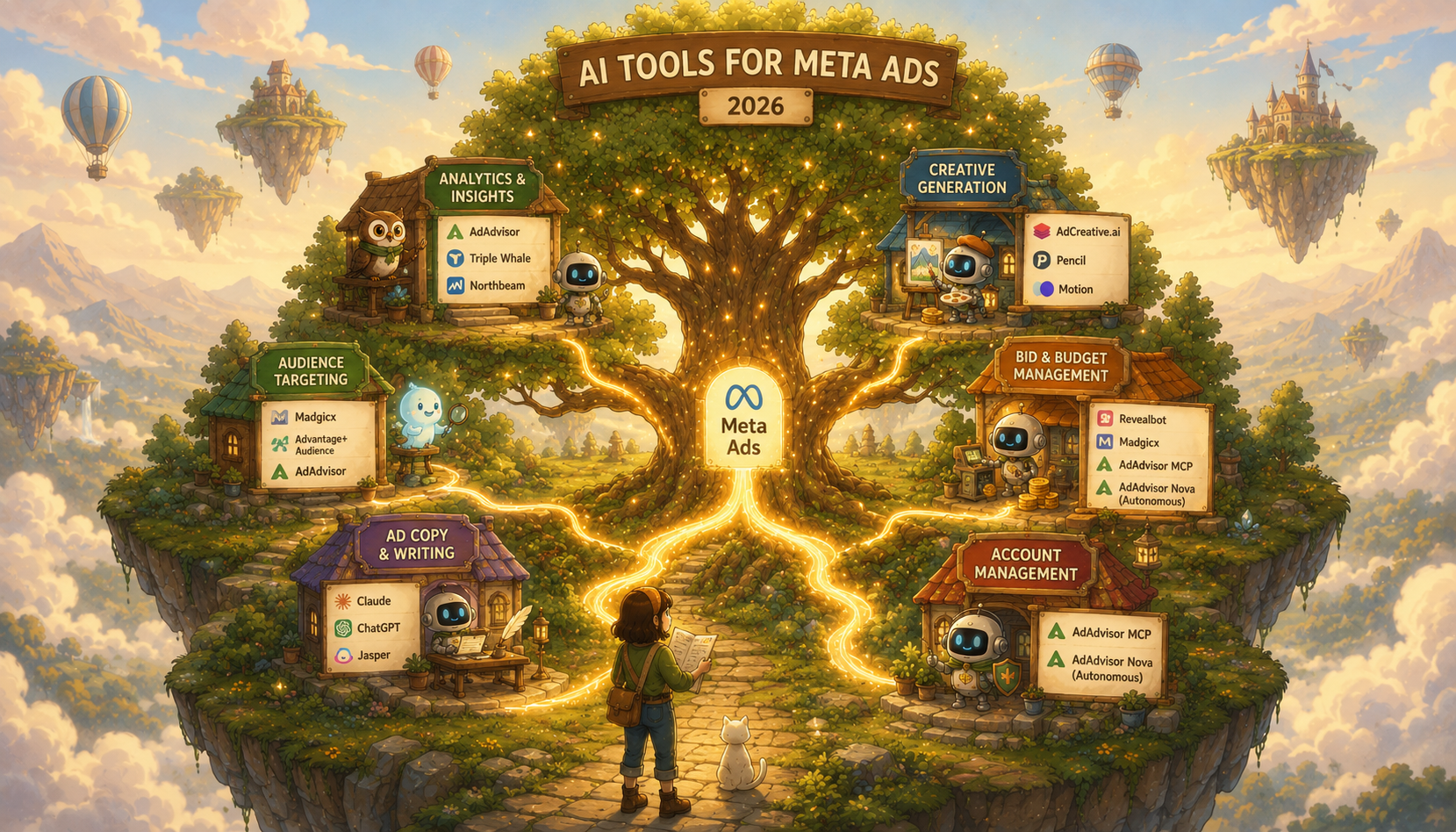
AI & Automation
Best AI Tools for Meta Ads in 2026 (Creative, Optimization & Automation)
AI for Meta Ads covers 6 job categories: analytics, creative, bidding, copy, audience, and account management. Here's which tool leads each one.
Read more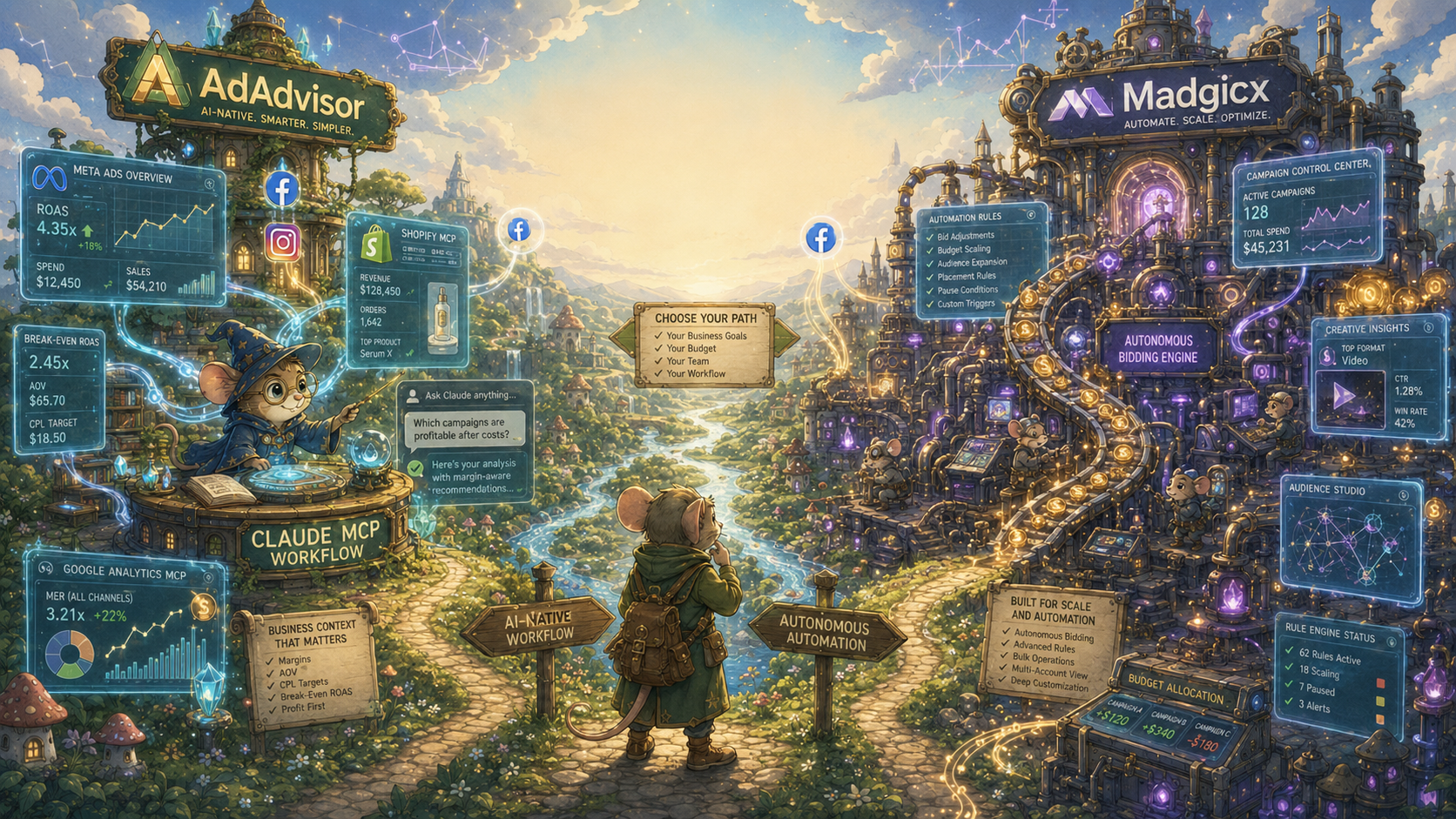
Industry News
AdAdvisor vs Madgicx (2026): Which Meta Ads Tool Actually Delivers?
Both AdAdvisor and Madgicx offer MCP connectivity for AI assistants. The real difference is in how each layers business context and margin-aware analysis on top of that connection. Here's how they compare - and who should use which.
Read more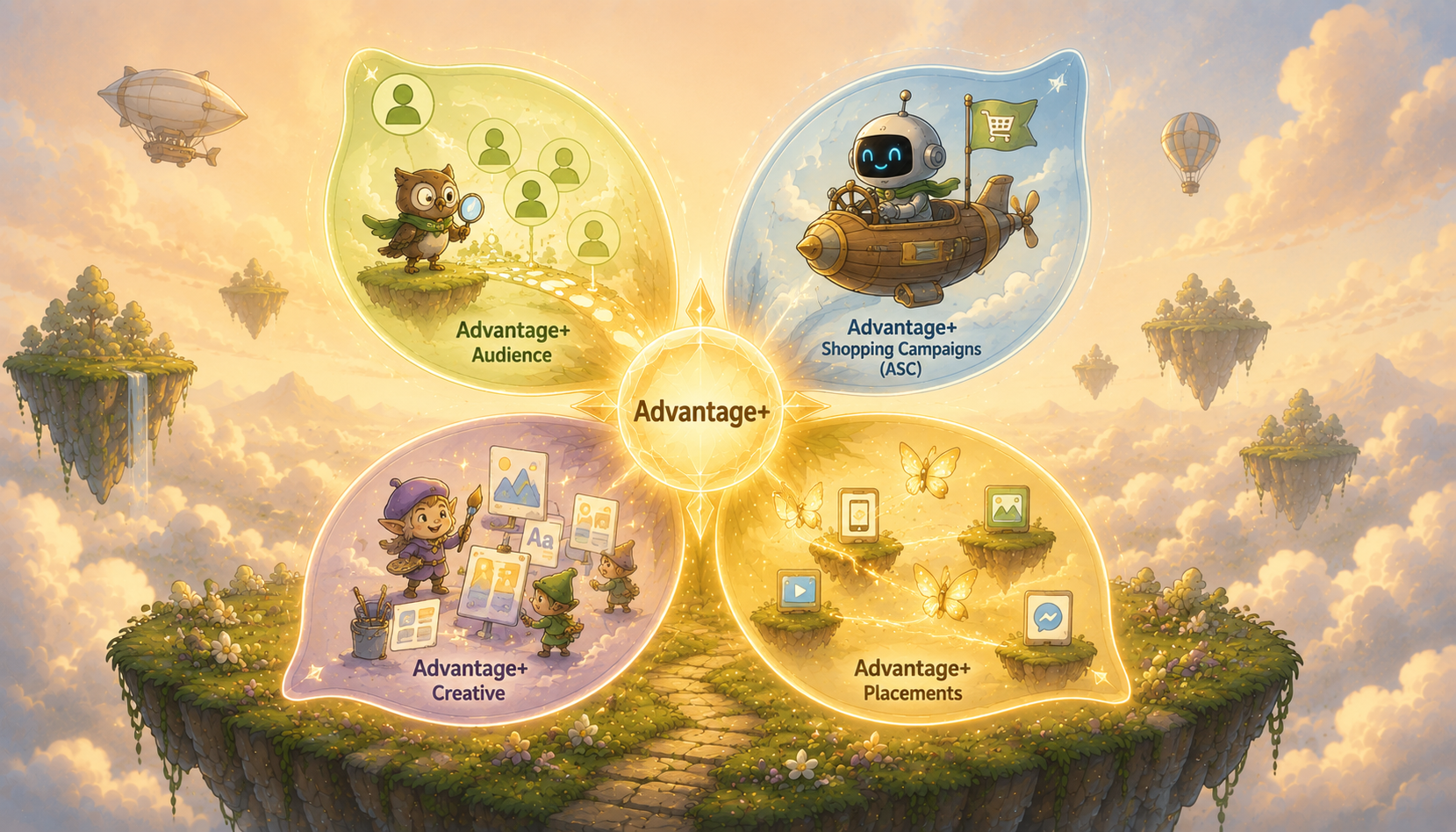
Strategy & Planning
Meta Advantage+: The Complete Guide to All Four Types (And When to Use Each)
Meta Advantage+ in 2026: Advantage+ Sales Campaigns (formerly ASC), plus Advantage+ Audience, Creative, and Placements. What each does and when to use each.
Read moreSources
- Facebook Ads Agency Pricing: What to Expect in 2026 (Stackmatix): percentage-of-spend and retainer ranges, setup fees, minimum spend.
- Meta Ads Management Cost & Pricing Guide 2026 (Ryze): 2026 agency fee benchmarks and models.
- Advantage+ Shopping Campaigns (Meta for Business): what Meta's native automation now handles.
- Ecommerce Customer Acquisition Cost Benchmarks 2026 (Ringly): CAC ranges and vertical differences for DTC.