TL;DR
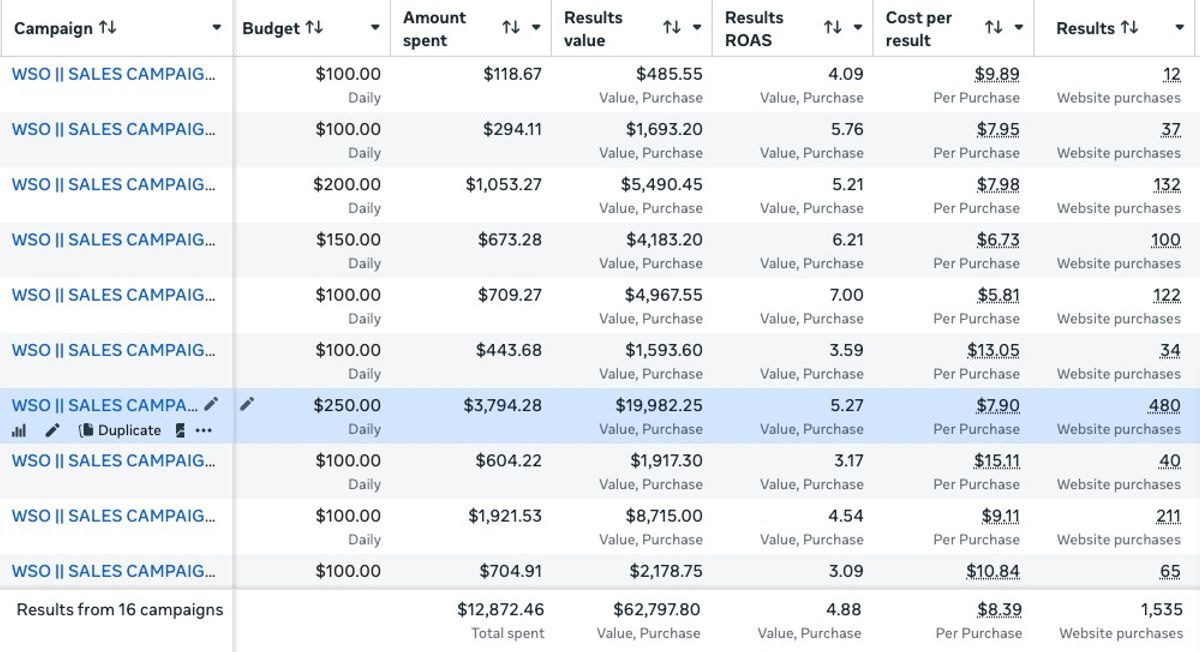
Scaling Facebook ads without killing ROAS means having three things in place before you touch the budget: your best creatives, your best audiences, and your break-even ROAS. Once you have those, scaling is a process of combining high-performing assets and increasing spend in controlled steps, not guesswork. A ROAS dip during scaling is normal and often still profitable. In one real account running 16 campaigns, the highest-spend campaign ($250/day, 5.27 ROAS) generated $19,982 in revenue — four times more than the highest-ROAS campaign ($100/day, 7.00 ROAS) in the same account.
Quick Answer
1. Don't scale first. Test creatives and audiences in separate campaigns before increasing budget.
2. Know your break-even ROAS. Scaling at a lower ROAS can generate more total profit than a high ROAS at low spend.
3. Combine winners. Pair your top creatives with your top audiences before pushing budget.
4. Fix drop-offs before scaling. Improving your landing page from 4.0 to 4.5 ROAS creates the margin that makes a budget increase safe.
5. A ROAS dip is not failure. In a real 16-campaign account, $250/day at 5.27 ROAS generated $19,982 versus $4,968 for the $100/day campaign at 7.00 ROAS.

Drowning in Meta Ads?
Put your campaign on autopilot with Nova.
Read moreWhy Facebook ad scaling kills ROAS (and how to stop it)
Most accounts follow the same arc. A campaign performs at $50–$100/day, so the budget doubles. Then ROAS collapses, and the post-mortem is always the same: they scaled before they had enough data.
Every significant budget change pushes Meta's algorithm back into the learning phase. That resets weeks of delivery optimization, producing unpredictable CPMs, inflated costs, and what looks like a broken campaign, even when the creative and audience are actually fine.
Three things cause it almost every time:
- Scaling before identifying winning creatives
- Scaling before validating winning audiences
- Scaling without a known break-even ROAS
Run the pre-scaling sequence. That's how you avoid all three.
The three data points you need before scaling
You need three things before touching the budget: your best creatives, your best audiences, and your break-even ROAS. They come from dedicated testing campaigns, not assumptions, not a single good week.
Campaign 1: creative testing
Run 5–10 creative variations against a broad or proven audience. Keep targeting, budget, and bidding identical across every ad set. Don't draw conclusions until each ad set has 50+ conversions.
You're looking for creatives that consistently generate strong ROAS and low CPA. The format, angle, hook, and offer behind those winners become the blueprint for everything you produce going forward.
Campaign 2: audience testing
Take your top 2–3 winning creatives and test them against different audiences: interest stacks, lookalike percentages (1%, 3%, 5%), demographic subsets. This campaign tells you which audiences work and surfaces your best-performing demographic data — age ranges, genders, placements — which feeds every future scaling decision.
The combination phase
Once you've confirmed winning creatives and winning audiences, build your scaling campaigns deliberately:
- Top 5–10 creatives paired with your best-performing audience
- Top-performing demographics paired with your best creatives
- Full stack: best demographics + best audience + best creatives together
If all three combinations hold profitability, you have a scalable system. Not a lucky campaign.
Key Takeaway
The sequence matters. Creatives first, audiences second, combinations third. Jumping straight to scaling before running both tests is the fastest way to burn budget on a campaign you don't actually understand yet.
Definition: Scaling Stability Threshold
The Scaling Stability Threshold is the minimum set of campaign conditions that must be confirmed before a budget increase is safe. A campaign that hasn't cleared this threshold isn't ready to scale, regardless of how strong the ROAS looks on any given day.
Scaling Stability Threshold checklist
| Condition | Minimum requirement |
|---|---|
| ROAS stability | Above break-even for 7+ consecutive days |
| Conversion volume | 50+ conversions per ad set |
| Frequency | Below 3.0 |
| Landing page conversion rate | Stable or improving |
| CPA trend | Stable, not rising week-over-week |
All five conditions. Four out of five isn't enough.
Key Takeaway
A campaign that passes four conditions might look ready. It isn't. The Scaling Stability Threshold exists precisely because one unstable variable will surface after the budget increase, not before.
Why a ROAS dip during scaling is normal
A ROAS drop during scaling isn't failure. It's what happens when you reach a broader, colder audience, and it's usually irrelevant to actual profitability.
Here's real campaign data from the same Meta Ads account. Several campaigns ran at $100/day, some with higher ROAS than the scaled campaign. One ran at $250/day with a 5.27 ROAS.
Real account data: 16 campaigns
| Campaign | Budget | Amount spent | Total revenue | ROAS | Purchases |
|---|---|---|---|---|---|
| Best $100/day campaign | $100/day | $709.27 | $4,967.55 | 7.00 | 122 |
| $100/day campaign | $100/day | $294.11 | $1,693.20 | 5.76 | 37 |
| $150/day campaign | $150/day | $673.28 | $4,183.20 | 6.21 | 100 |
| Scaled campaign (top performer) | $250/day | $3,794.28 | $19,982.25 | 5.27 | 480 |
| Account total (16 campaigns) | - | $12,872.46 | $62,797.80 | 4.88 | 1,535 |


Total purchases (16 campaigns)
Total revenue generated
Blended ROAS across all campaigns
Budget of the top-performing campaign
The $250/day campaign had a lower ROAS than three others in the same account and generated $19,982 in revenue versus $4,968 for the highest-ROAS campaign. Four times more revenue. Four times more purchases. From the campaign that most advertisers would flag as underperforming if they were watching ROAS alone.
Across all 16 campaigns: 1,535 purchases, $62,797 in revenue, 4.88 blended ROAS on $12,872 spent, most of it driven by the scaled campaign.
Watching ROAS without knowing your break-even is how accounts leave money on the table. The number by itself tells you almost nothing.
Key Takeaway
If you'd been optimizing toward the highest ROAS in that account, you'd have paused the $250/day campaign and scaled the $100/day one. That's the wrong call by a factor of four. Check your break-even before drawing any conclusions from a ROAS number.
Definition: What is break-even ROAS?
Break-Even ROAS
Break-Even ROAS is the minimum return on ad spend at which a business covers all costs, fixed and variable, and reaches zero net profit. Any ROAS above that point generates profit. Any ROAS below it generates a loss.
Break-even ROAS formula:
Break-Even ROAS = Total Revenue Required ÷ Ad SpendWhere Total Revenue Required = all fixed costs + variable costs + desired profit margin, expressed as a multiple of ad spend.
The Fixed-Cost ROAS Floor
Fixed-Cost ROAS Floor
The Fixed-Cost ROAS Floor is the effect by which a business's real break-even ROAS decreases as ad spend and revenue grow, because fixed costs get spread across a larger revenue base.
Fixed costs don't change when ad spend goes up. Office rent, employee salaries, warehouse costs, software subscriptions. Same bill whether you're spending $100/day or $500/day. An employee costing $3,000/month costs the same whether ads generate $10,000 or $30,000 in monthly revenue.
Break-even ROAS isn't a fixed number. As revenue grows, the break-even threshold drops, which means a higher-spend campaign at a lower ROAS can be structurally more profitable than it looks.
Break-even ROAS decreases as ad spend grows
| Monthly ad spend | Fixed costs | Variable costs | Break-even ROAS |
|---|---|---|---|
| $3,000 | $5,000 | 40% of revenue | 3.6 |
| $7,500 | $5,000 | 40% of revenue | 2.8 |
| $15,000 | $5,000 | 40% of revenue | 2.3 |
The ad spend tripled. The break-even ROAS dropped by 36%.
Key Takeaway
Recalculate your break-even ROAS at every new spend level. A 3.2 ROAS that looked risky at $3,000/month might be comfortable at $7,500/month once you run the actual numbers.
Horizontal vs. vertical scaling: which to use and when
What is horizontal scaling in Facebook Ads?
Horizontal scaling in Facebook Ads means expanding reach by duplicating winning campaigns into new audiences, placements, or demographic segments, instead of increasing budget on a single existing ad set. It adds volume without saturating the current audience.
What is vertical scaling in Facebook Ads?
Vertical scaling in Facebook Ads means increasing the budget on a winning campaign or ad set to reach more people within the same audience. It's faster than horizontal scaling but carries higher saturation risk.
Horizontal vs. vertical scaling comparison
| Factor | Horizontal scaling | Vertical scaling |
|---|---|---|
| Risk level | Lower | Higher |
| Speed | Medium | Faster |
| Algorithm disruption | Minimal | Moderate (if >30% jumps) |
| Best use case | Early scaling, fatigue prevention | Proven campaigns with room to grow |
| Primary method | Duplicate ad sets into new audiences | Increase budget 20-30% every 3-5 days |
| Saturation risk | Low | High at extended scale |
Use horizontal scaling when starting to scale for the first time, when CPMs are rising on current ad sets, when frequency is approaching 3–4, or when you want to test new demographic combinations.
Use vertical scaling when the campaign has cleared the Scaling Stability Threshold, frequency is below 3, budget increases stay at 20–30% per adjustment, and ROAS has been stable for 7+ days post-increase.
Horizontal scaling tactics:
- Duplicate winning ad sets into new interest audiences
- Create lookalike audiences at 1%, 3%, and 5% from your buyer list
- Test winning creatives against different demographic segments
- Expand to new placements: Reels, Stories, Instagram Feed
Key Takeaway
Scale wide before you scale deep. Horizontal expansion buys time and data before you start pushing vertical budget increases on a single audience.
The Creative Saturation Ceiling
Creative Saturation Ceiling
The Creative Saturation Ceiling is the point at which an audience has seen a creative often enough that engagement drops, CTR declines, and CPM rises, regardless of budget or audience changes. Once a campaign reaches its Creative Saturation Ceiling, no budget increase restores previous ROAS without new creative.
Creative saturation signals
| Metric | Healthy | Warning | Action required |
|---|---|---|---|
| Frequency | < 3.0 | 3.0–4.0 | Prepare new creatives |
| CTR | Stable or rising | Declining 2+ weeks | Refresh creative |
| CPM | Stable | Rising with stable CTR | Expand audience |
| ROAS | Above break-even | Declining weekly | Audit creative and audience |
Scaling budget into a campaign that's approaching its ceiling makes the decline happen faster. Get new creatives into testing before frequency hits 4.0. Not after the numbers have already started sliding.
Key Takeaway
New creatives should be in rotation before the current ones hit the ceiling, not after. By the time ROAS starts dropping from fatigue, you're already behind.
Landing page testing as a scaling multiplier
If your funnel has holes, more ad spend just means more people falling through them at a higher cost. Scaling a leaky funnel doesn't fix the leak.
Pre-scale landing page process
Read the data
Find the highest drop-off point in the customer journey.
Fix one variable at a time
CTA copy, page speed, social proof, or offer clarity. One at a time.
Confirm a measurable ROAS improvement
Wait for the data to confirm improvement before touching the budget.
Then scale
Only increase budget after step 3 shows a clear win.
Landing page optimization example
| Step | Action | Result |
|---|---|---|
| Baseline | Campaign at $100/day | 4.0 ROAS |
| Optimization | New landing page layout | 4.5 ROAS |
| Scale | Budget increased to $200/day | ROAS settles at 4.0 |
| Outcome | Spend doubled, profitability maintained | Win |
The landing page improvement created headroom for the post-scale ROAS dip. When budget doubled and ROAS settled back at 4.0, the account was running double the spend at the same profitability. That's the outcome worth chasing.
Key Takeaway
Every 0.5 ROAS improvement before scaling creates room for the dip that comes after. Fix the funnel first.
How to monitor Facebook ads while scaling
Once you're actively scaling, check these five metrics every day. The individual numbers matter less than how they move in relation to each other.
Daily scaling metrics
| Metric | Healthy range | Warning signal | What it indicates |
|---|---|---|---|
| ROAS | Above break-even | Below break-even | Overall profitability |
| CPA / CAC | Within 20% of pre-scale | Rising >20% over 5 days | Delivery efficiency |
| Frequency | < 3.0 | > 4.0 | Creative fatigue risk |
| CPM | Stable | Rising with stable CTR | Audience saturation |
| CTR | Stable or rising | Declining 2+ weeks | Creative exhaustion |
Set up a custom column view in Meta Ads Manager showing ROAS, frequency, CPM, and CTR side by side. That single view makes the relationship between rising frequency and declining ROAS visible without having to dig.
AdAdvisor handles this monitoring automatically, analyzing Meta Ads performance in real time, identifying underperforming creatives and ad sets, and surfacing budget reallocation opportunities before fatigue shows up in ROAS.
Key Takeaway
Rising CPM with stable CTR means audience saturation. Falling CTR with rising frequency means creative fatigue. Different causes, different fixes. Don't treat them the same way.
Using Meta automation to protect ROAS at scale
Advantage+ Shopping Campaigns (ASC) let Meta's algorithm handle creative, audience, and placement optimization automatically. ASC works best for e-commerce accounts that have accumulated 500+ purchases in the last 30 days.
Facebook ad automation tools, including Meta's own Automated Rules, enforce scaling discipline without requiring manual monitoring every day:
- Pause ad sets automatically if CPA exceeds your target by 30%
- Increase budget by 20% when ROAS exceeds target for 3 consecutive days
- Alert when frequency crosses 4.0
- Pause creatives when CTR drops below your baseline for 7 days
Automation doesn't replace judgment. It stops you from making reactive decisions when ROAS dips for three days and you're tempted to blow up a campaign that's re-optimizing just fine on its own.
Troubleshooting: why ROAS drops after scaling
ROAS collapses immediately after budget increase: Budget jumped more than 30% in one change. Reduce to the previous level, wait 48–72 hours, then scale again at a smaller increment.
ROAS declines steadily over 2–3 weeks: Either audience saturation or the Creative Saturation Ceiling. Check frequency first. If it's above 4.0, add new creatives now. If CPMs are rising but CTR is stable, the audience is saturating, not the creative — expand horizontally.
ROAS drops after scaling but holds above break-even: Normal. Meta's algorithm is re-optimizing for the larger audience and higher budget. Give it 7–10 days before drawing conclusions.
ROAS was already unstable before scaling: The campaign hadn't cleared the Scaling Stability Threshold. A couple of strong days isn't a trend. Go back to testing and don't increase budget until there are 7 consecutive stable days.
Frequently asked questions
Summary
No shortcuts here. Scaling without killing ROAS means doing the work before the budget increase, not scrambling to figure out why it broke after.
The process in order:
- Test creatives first. Campaign 1 tells you what actually works.
- Test audiences second. Campaign 2 tells you who responds best.
- Build combination campaigns. Stack the winners together before scaling anything.
- Clear the Scaling Stability Threshold. All five conditions. Seven days of stable data.
- Fix landing page drop-offs. Get 0.5 ROAS of headroom before touching the budget.
- Scale horizontally before vertically. New audiences before bigger budgets on existing ones.
- Increase budgets 20–30% every 3–5 days. Large jumps reset the learning phase.
- Watch the Creative Saturation Ceiling. Frequency above 4.0 means you're already behind.
- Evaluate ROAS against break-even, not against your best day. The Fixed-Cost ROAS Floor means your break-even shifts as spend grows.
Sustainable scaling isn't about finding one winning campaign and running it into the ground. It's about building a system: tested creatives, tested audiences, a funnel that holds. Then running that system at increasing volume without it coming apart. That system rests on the same Facebook ads best practices: clean structure, specific creative, and patience with the learning phase.