TL;DR
Meta AI vs Claude comes down to two different kinds of tool, not one being smarter than the other. Meta AI (Advantage+ and Business AI) is native automation that optimizes inside Meta with little human input. Claude is an external assistant that, through a connector, reads and acts on your account under your direction. For hands-off scaling, Meta AI wins. For transparency and control, Claude plus a connector is stronger. They can also work together.
This article is for advertisers and agencies deciding between Meta's built-in AI and driving their ads with an external AI assistant like Claude.
What this article covers, and what it does not. This is a comparison of two categories of tool: native automation versus an external assistant. It does not rank one AI assistant against another (for that, see ChatGPT vs Claude for Meta Ads), it does not rank MCP servers (see the best MCP server guide), and it does not walk through Advantage+ setup (see the Meta Advantage+ guide). The single question here is native automation versus assistant-driven control.
One thing to get straight first: "Meta AI" here means Advantage+, not Meta's MCP. Meta AI in this comparison is Meta's native automation (Advantage+ and Business AI), the auto-pilot built into the ad platform. It is not the same as Meta's official Ads MCP (Meta Ads AI Connectors), which is just a connector that lets external assistants like Claude or ChatGPT reach your account. The MCP is a pipe, not the AI. In this article, that connector belongs to the "Claude" side, because it is one of the ways Claude can plug into your account. So the comparison is Meta's auto-pilot versus an assistant you steer, not Meta's connector versus Claude.
Quick Answer: When Each One Wins
Here is the short version before the detail:
- Meta AI wins when you want hands-off scaling. Advantage+ campaigns let Meta's own AI manage audience, placement, and budget inside the platform with almost no manual work.
- Claude wins when you want transparency and control. Claude reasons over your account data and proposes or makes specific changes you can see and approve, rather than optimizing behind a closed loop.
- They are complementary, not mutually exclusive. Many operators let Advantage+ handle broad delivery while using Claude to interrogate performance and direct precise changes.
- Claude cannot touch your ad account on its own. It needs a connector, typically an MCP server, to read data and take action, which is the single most important caveat in this comparison.
- The choice is native automation vs assistant-driven control, and that framing decides which fits your workflow.

Drowning in Meta Ads?
Put your campaign on autopilot with Nova.
Read moreThe Real Distinction: Native Automation vs Assistant-Driven Control
The question that actually matters is not "which is smarter." It is which category of tool matches how you want to run the account. Meta AI and Claude sit in two different categories.
Meta AI is native automation. Advantage+ and Business AI live inside Meta and optimize toward your objective automatically. You set the campaign, and the system decides audience, placement, and budget allocation on its own. The optimization happens inside a closed loop: you see outcomes such as spend and results, but not the reasoning behind each decision. It is hands-off by design, which is its strength and its limit.
Claude is assistant-driven control. Claude does not run inside Meta. It reasons over your account data and then, through a connector, reads performance and acts on the account under your direction. That connector is often an MCP server: MCP (Model Context Protocol) is the standard Anthropic introduced in November 2024 for linking AI assistants to external tools. It is growing fast but is not yet the dominant way ads tools integrate; custom API integrations, middleware, and SaaS platforms are still common. You ask a question, Claude explains what it sees, and it proposes a change you can inspect first. The point is that its interpretation is visible, though that interpretation is Claude's read of the data, not guaranteed truth.
So the real comparison is native automation (optimize for me, quietly) versus assistant-driven control (reason with me, visibly). Meta AI removes work. Claude makes the reasoning inspectable and usually keeps a human in the loop. The real ecosystem is broader than two boxes, since it also includes rule-based automation, SaaS optimization platforms, and custom machine-learning systems. The two-category lens is a useful simplification for the choice most operators actually face, not a claim that nothing else exists.
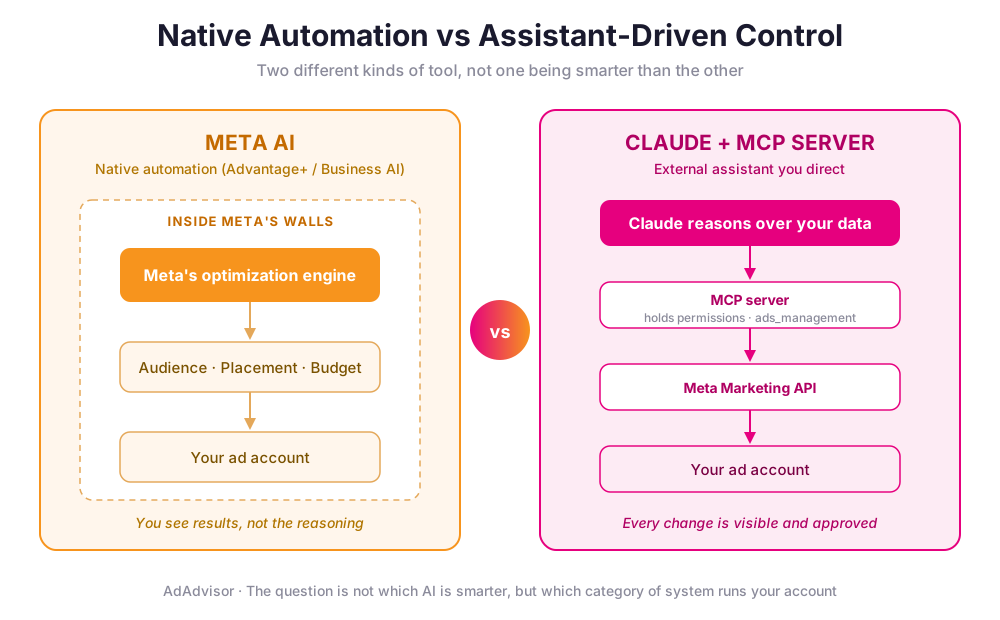
The question is not which AI is smarter. It is which category of system you want running your account.
Meta AI vs Claude: Head-to-Head
The table below compares Meta AI and Claude (the reverse phrasing, Claude vs Meta AI, points to the same comparison) across the fifteen factors that decide day-to-day fit.
Meta AI vs Claude across fifteen decision factors
| Factor | Meta AI (Advantage+ / Business AI) | Claude + connector |
|---|---|---|
| Control | Low. Meta decides delivery inside its own system. | High. You direct or approve each change. |
| Transparency / explainability | Opaque. You see outcomes, not the reasoning. | Explains its interpretation in plain language. That reasoning is its read of the data, not guaranteed ground truth. |
| Auditability | Weak. No decision log you can inspect. | Stronger. Each change maps to a named API call you can log and review. |
| Reproducibility | Low. You cannot replay why a choice was made. | Decisions are on the record; the outcome still varies with the live auction, so results are not deterministic. |
| Scope of action | Delivery inside Meta only (audience, placement, budget). | Reads performance and, with ads_management, edits budgets, statuses, and structure. |
| Business-context awareness | Strong on in-platform signals Meta collects; blind to context outside Meta. | You can feed it margins, LTV, and goals, but it lacks Meta's internal delivery signals. |
| Margin-aware decisions | Indirect. Approximates value with value optimization, conversion value rules, and CAPI, not your true margin. | Can weigh your actual margins when you supply them; quality depends on the setup (AdAdvisor MCP is built for this). |
| Multi-account workflow | Per-account delivery; Business Manager does offer cross-account reporting. | One assistant can reason across several accounts you connect. |
| Learning curve | Low. Turn it on and let it run. | Moderate. Requires a connector and prompt-based direction. |
| Speed to first result | Fast. Launch and delivery begins. | Slower to set up, faster for repeat analysis afterward. |
| Human-in-the-loop | Minimal by design. | Common in practice, and how AdAdvisor MCP is built: you approve changes before they execute. |
| Compliance and permissions | Managed entirely by Meta. | Governed by the connector's granted scopes; external changes carry their own policy and rate-limit risk. |
| Cost | Included with ad spend; no separate tool cost. | Cost of a Claude plan plus a connector. |
| Best for | Hands-off scaling inside Meta. | Hands-on control, explainability, and profit-aware analysis. |
| Fails when | You need to know why, or to weigh outside context. | No connector is set up, the data is noisy enough to mislead it, or you want full autopilot out of the box. |
Meta AI removes work. Claude makes the reasoning visible.
The position: for fully hands-off scaling within Meta's walls, Advantage+ is the stronger choice. For hands-on operators who want to understand and steer decisions, Claude plus a connector is likely the better fit, because it turns optimization from something that happens to your account into something you can inspect and direct. This is not a claim that Claude decides better than Meta; it is a claim that you can see and shape the decision. The head-to-head does not produce a tie; it produces a fork based on how much visibility and control you want.
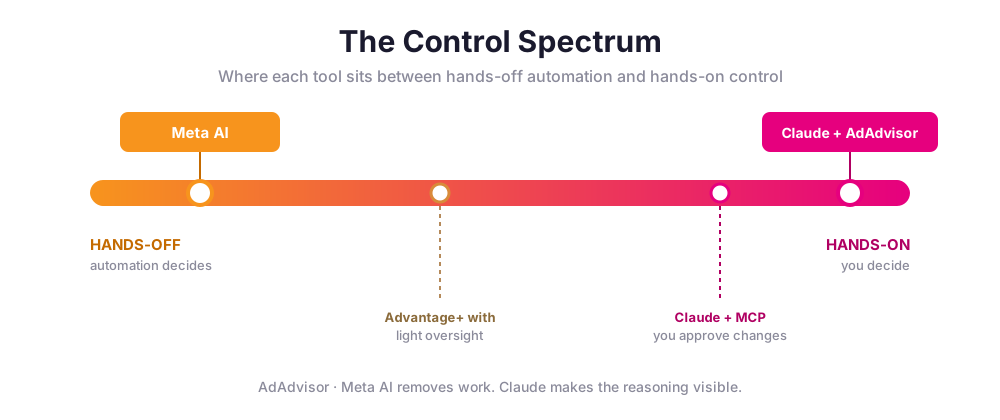
What Each One Cannot Do
Strengths only tell half the story. The limits are where the fork gets sharp.
| Meta AI cannot | Claude cannot |
|---|---|
| Explain why it made a specific delivery choice. | Touch your account without a connector or API layer. |
| Optimize directly to your true profit margin, only approximate value with its own signals. | Guarantee its reasoning is correct; it can be plausible but wrong on noisy data. |
| Weigh context that lives outside Meta (LTV, inventory, seasonality you know). | See the internal delivery and conversion signals Meta models. |
| Give you an inspectable, per-decision action log. | Run fully hands-off in a standard setup, though autonomous workflows can be built with guardrails. |
How Each One Works on Your Account
The mechanics explain why one keeps its reasoning inside the platform and one exposes it.
Meta itself is moving onto both sides of this line: it runs native automation through Advantage+ and in 2026 began rolling out official AI connector access (Meta Ads AI Connectors) that lets external assistants read and act on accounts. Availability and exact naming are still evolving, so treat this as an emerging capability rather than a settled, universal product. Either way, it makes the native-versus-assistant distinction more relevant, not less.
Diagrams available
Five branded SVG visuals accompany this article (native-vs-assistant architecture, control spectrum, decision tree, workflow comparison, and hybrid architecture). Drop them in as images where the diagrams are referenced below.
The two workflows look different at every step:
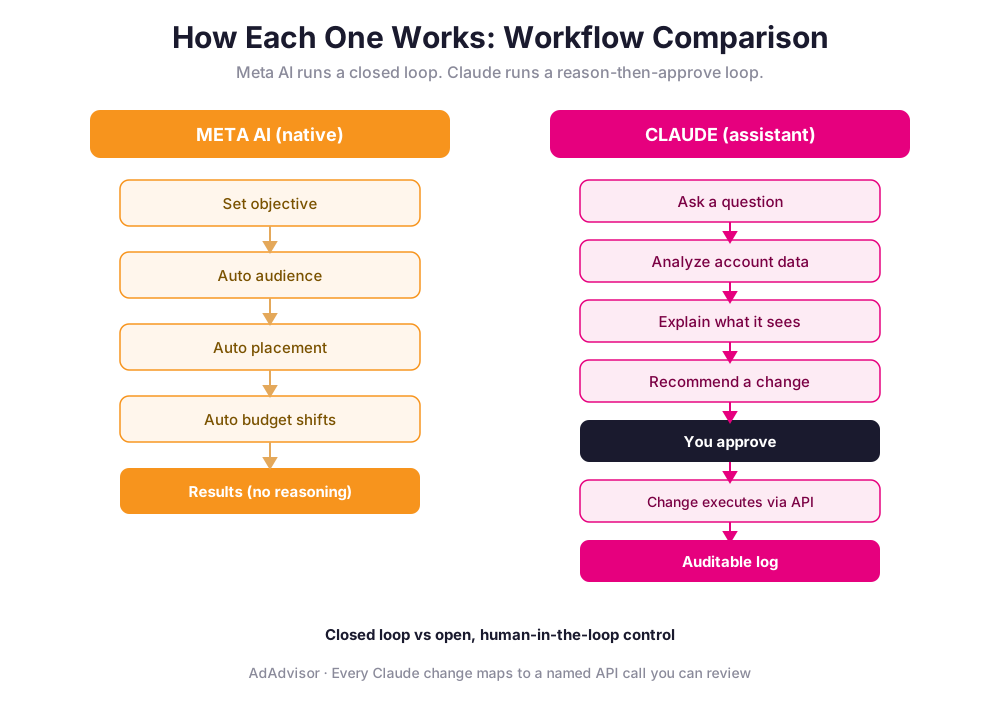
Campaign launch and optimization: closed loop vs reason-then-approve loop
| Meta AI (native) | Claude (assistant) |
|---|---|
| Set objective | Ask a question |
| Auto audience | Analyze account data |
| Auto placement | Explain what it sees |
| Auto budget shifts | Recommend a change |
| Results back (no reasoning) | You approve |
| Change executes via API | |
| Auditable log |
Meta AI (Advantage+). You define the campaign objective and budget, and Meta's AI takes over delivery. It tests audiences, chooses placements across Facebook and Instagram, and shifts budget toward whatever is performing. All of this happens inside Meta's infrastructure. You get results and spend back, but the decision path stays inside the platform. When Advantage+ scales a winning ad, it is likely reading engagement and conversion signals you never see directly. For a full breakdown of what Meta Ads AI actually does; this section stays at the level needed for the comparison.
Claude plus a connector. Claude has no native access to your ad account. It connects through a connector, typically an MCP server, that speaks to the Meta Marketing API. Once connected, Claude can read performance data, and if the connector is granted the ads_management scope, it can make changes you direct or approve. Ask "which ad sets are likely wasting budget this week," and Claude reads the data, explains its read, and proposes specific pauses or budget shifts for you to confirm. This kind of write-access workflow is still early and not yet standard practice across most advertisers, so treat it as an emerging setup rather than the norm.
Here is the expert point on why assistant-driven access is more inspectable. Advantage+ optimizes inside a closed loop, so the reasoning is not exposed. Claude acts through the documented Meta Marketing API, where every change maps to a named endpoint and the ads_management permission in your Business Manager. That means each action is an explicit, loggable step rather than a hidden one. You can audit what changed, and see the reasoning Claude gave, though that reasoning is its interpretation and can be wrong on noisy data. This is why the connector matters so much: it is what links Claude to the Meta Marketing API and controls exactly what Claude is allowed to do.
AdAdvisor MCP is one such connector, built by a team that states 8 years in paid social, more than $60M in managed ad spend, and an ex-Meta developer among its founders. AdAdvisor positions it as a managed, margin-aware way to give Claude that access, with Meta App Review completed for read and write and a design that aims to keep changes safe and optimizing. The human-in-the-loop workflow described throughout this comparison, where changes are proposed and you approve them before they execute, is how AdAdvisor MCP is built to operate. If you want the full mechanics of the connection layer, see the Facebook Ads MCP pillar.
AdAdvisor Nova: both modes in one tool
The approve-first model is not the only way operators want to work. AdAdvisor Nova closes that gap: you choose the level of autonomy. Run her on full autopilot and let her act on the account the way native automation does, or keep yourself in the loop and approve the main decisions before they go live. One tool gives you both modes, so the native-versus-assistant fork becomes a setting you control rather than a category you are locked into. Nova is running live accounts today, with access by application while the founding cohort onboards.
A Concrete Example: A $50k/Month Ecommerce Account
Picture a store spending $50,000 a month across ten ad sets, targeting a 3x return.
With Meta AI alone. You launch Advantage+ Shopping campaigns and Meta allocates budget toward whatever drives the most purchases inside its model. Spend concentrates on the ad sets Meta favors. You can nudge it toward value with conversion value rules and value optimization, but unless you have modeled margin into those signals, a segment that is likely converting at a low margin can still absorb budget, because the default objective is purchases, not your profit.
With Claude alone. You ask Claude to review the account. It reads the data, flags that two ad sets are likely draining budget at a return below break-even, and proposes pausing them and shifting spend. You check its read, approve, and the changes execute through the Meta Marketing API. You saw the reasoning and kept control, but you had to be in the loop for it to act, and you had to sanity-check its interpretation.
With both. Advantage+ handles broad delivery and creative rotation while Claude runs a weekly margin-aware review, likely surfacing low-profit pockets the default objective misses and proposing precise corrections you approve. Automation covers reach; the assistant covers judgment you can inspect.
Meta AI optimizes toward its objective. Claude can weigh your true margins, when you supply them, because that context lives outside Meta.
Who Should Use Meta AI vs Claude
Match the tool to the operator profile. Start with the decision tree, then check the matrix.
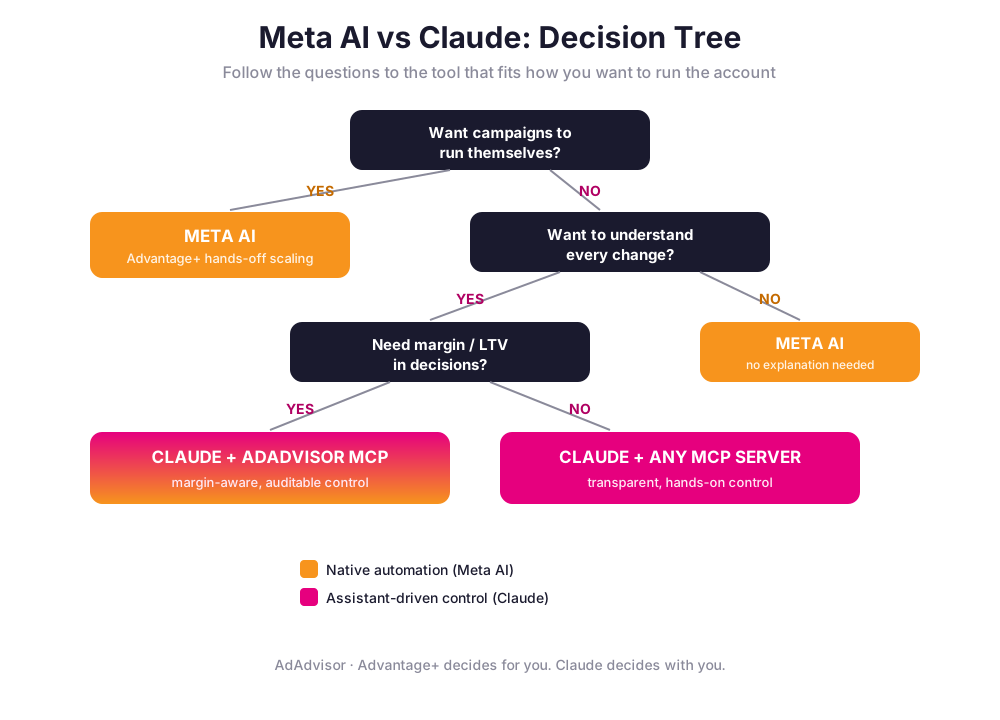
Figure: which side of the fork you land on depends on control and profit needs, not on which AI is "smarter."
Decision Matrix
| Situation | Best choice | Why |
|---|---|---|
| New advertiser | Meta AI | Lowest setup, solid baseline delivery. |
| Hands-off SMB | Meta AI | Wants results without daily management. |
| Solo performance buyer | Claude + connector | Wants control and explainability without a team. |
| Agency (multi-account) | Claude + AdAdvisor MCP | Reasons across accounts, margin-aware, auditable. |
| Enterprise / in-house team | Claude + AdAdvisor MCP | Needs governance, audit trail, profit-aware calls. |
| High-budget scaling | Both | Advantage+ for reach, Claude for margin control. |
Typical operator: Meta AI skews toward new advertisers and hands-off SMBs; Claude plus a connector skews toward performance buyers, agencies, and in-house teams. This is the profile that benefits most from treating Claude as an AI media buyer that works from your data and your goals.
How to Actually Use Both: The Hybrid Architecture
"Use both" is the common recommendation, so here is the shape of it. Claude sits on top as the reasoning and control layer; Meta AI stays underneath as the delivery engine.
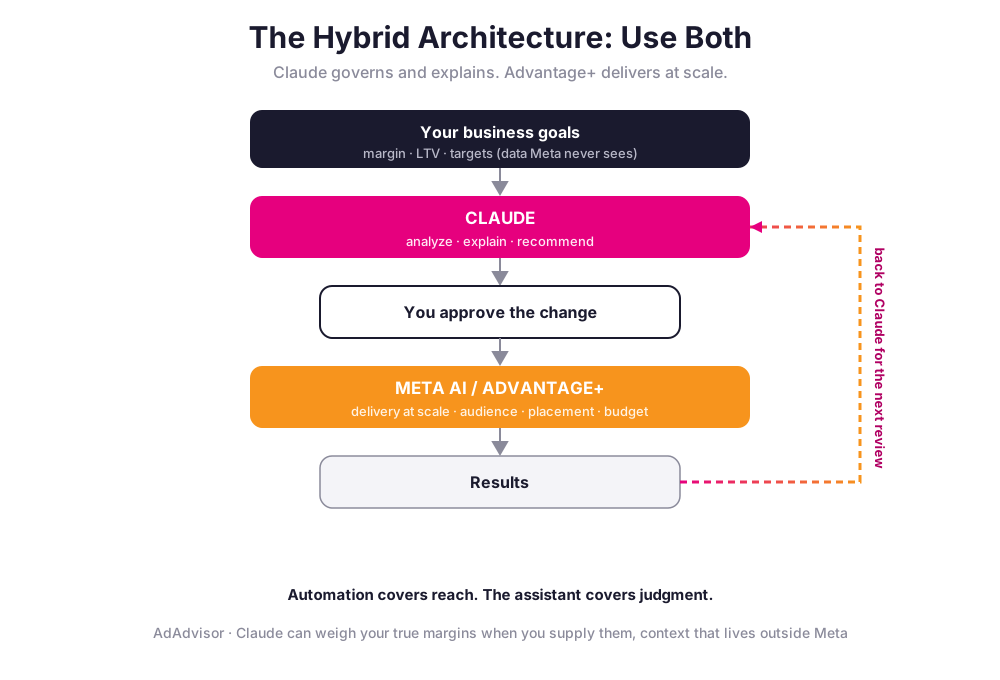
Figure: Claude governs, Advantage+ delivers. The margins and goals enter at the top, where Meta AI cannot see them.
If your real question is which external assistant to drive ads with, see ChatGPT vs Claude for Meta Ads.
Common Misconceptions
Two mix-ups cause most of the confusion in this comparison.
Meta AI is not Meta's MCP
Meta AI means Advantage+ and Business AI, the native automation inside the platform. Meta's official Ads MCP (Meta Ads AI Connectors) is a connector that lets external assistants reach your account. One is the auto-pilot; the other is a pipe. They are different products that happen to come from the same company.
Claude is not direct API access
Claude does not call the Meta Marketing API by itself. It reasons, and a connector does the calling. The connector is what holds the permissions and executes the change, so the safety of the setup depends on the connector, not on Claude alone.
Caveats Worth Knowing
The comparison above is real, but a few things keep it honest.
Meta has a signal advantage you cannot replicate. Meta's delivery and conversion modeling runs on first-party engagement data that no external tool sees. That is a genuine edge for raw delivery, and it is why hands-off Advantage+ often performs well without help.
LLMs can be confidently wrong. Claude interprets noisy, delayed, and sometimes contradictory ad data. Its reads are usually useful but not guaranteed, so likely a good workflow keeps a human checking before changes go live.
External automation carries operational risk. API rate limits, reporting delays, and attribution mismatches between Meta and your own analytics can all distort what an assistant sees. Automating write actions from outside the platform also carries policy and account-safety risk that a managed connector should be built to manage.
None of this breaks the native-versus-assistant lens. It just means the honest framing is "visible, directable control that you still supervise," not "a smarter autopilot."
Future-Proofing: Two Paths That Evolve Separately
This choice is not frozen, and the two sides improve on different clocks. Meta AI evolves inside Meta's roadmap: new Advantage+ features, new automation, more of the account handed to the platform. You inherit those gains automatically, and you also inherit whatever opacity comes with them.
Claude evolves independently of Meta. Model upgrades make the reasoning sharper, and the connector layer widens what an assistant can safely touch. Because the assistant and the connector improve separately from Meta's platform, the assistant-driven path likely compounds in capability without waiting on Meta's release cycle. Betting on both hedges the two roadmaps against each other.
The line between the two paths has already started to blur. AdAdvisor Nova is built so you pick the autonomy level: full autopilot when you want native-style hands-off delivery, or approve-the-main-decisions when you want to stay in control. That turns the native-versus-assistant choice into a dial rather than a fork.
What neither column has
Read the two sides again and notice what is missing from both. Meta AI runs continuously but never sees your margins, your break-even ROAS, or what a customer is worth to you after ninety days. Claude sees all of that, because you tell it, but only while the conversation is open. The comparison treats continuous operation and business context as a trade you have to make, and until recently that is exactly what it was.
That is the dial Nova is built as. Nova is AdAdvisor's AI media buyer for Meta. Your break-even ROAS, margins, average order value, and target CPA are captured at onboarding, and she works the account against them continuously rather than only when you open a chat. Suggest mode keeps the approval gate this article argues for, since every action queues for your review before it runs. Autopilot removes the gate but not the guardrails, executing inside the spend caps, geographies, and exclusions you set and pinging you only when she hits something she cannot decide alone.
Nova is running live accounts today. Access is by application while the founding cohort onboards.
Frequently Asked Questions
Meta AI vs Claude: FAQ
Summary
Meta AI vs Claude is a choice between native automation and assistant-driven control. Meta AI (Advantage+) optimizes inside Meta with little input and suits hands-off scaling. Claude, through a connector, reads and acts on your account transparently and suits operators who want control. Many use both. If you are deciding which external assistant to drive ads with, see ChatGPT vs Claude for Meta Ads; to pick the connection layer, see the best MCP server for advertising. For step-by-step workflows, see how to use Claude for Meta ads with MCP, or start with the Claude Meta Ads automation workflow for beginners.
Keep reading
Strategy & Planning
ChatGPT vs Claude for Meta Ads: Which One Is Better?
Both work for Meta Ads. They're good at different things. Here's an honest comparison based on what actually matters for campaign management.
Read more
AI & Automation
Best Meta Ads MCP Servers in 2026: Ranked and Compared
Compare the best Meta Ads MCP servers in 2026, including Meta's official MCP (launched April 2026), AdAdvisor, Pipeboard, Ryze, and more. Find the right one for your workflow.
Read more