TL;DR
No, AI will not replace media buyers. It is already replacing the manual execution layer and much of the optimization layer, and that shift is real. But strategy, offer, creative judgment, and accountability stay human. The media buyers who thrive in 2026 stop competing with automation on speed and move up to the work AI cannot do: deciding what to build, what to test, and when to override the machine.
This article is for media buyers, agency staff, and freelancers worried about job security, and for agency owners rethinking how their teams are built.
Quick Answer: What AI Takes and What It Keeps
- AI reliably takes execution and monitoring. Building line items, shifting budgets between winning and losing ad sets, catching creative fatigue, and pulling reports. This work is faster, cheaper, and more consistent when a machine does it.
- AI takes much of optimization, with supervision. Bid adjustments and audience expansion are now largely automated inside platforms like Meta Advantage+. The buyer sets the guardrails; the system works inside them.
- AI does not take strategy. What offer to run, which market to enter, how to position the brand, and what a good result even looks like remain human calls.
- AI does not take accountability. When a campaign burns budget on the wrong audience, a person answers for it, not an algorithm.
- The one-line conclusion: AI is replacing the parts of media buying that were always mechanical. The parts that were always judgment are becoming more valuable, not less.

Drowning in Meta Ads?
Put your campaign on autopilot with Nova.
Read moreWhy This Question Is Everywhere in 2026
The fear is new because the capability is new. In its own earnings reporting, Meta has said its Value Optimization suite passed a $20 billion annual revenue run-rate, and that 8 million advertisers now use at least one of its AI ad creative tools, double the number at the end of 2024. On the agentic side, the shift is concrete: in January 2026 PubMatic launched AgenticOS, an agent-to-agent advertising operating system where advertisers define goals and guardrails and a coordinated set of agents plans and optimizes within them. Meta, in turn, opened Meta Ads AI Connectors in open beta, letting advertisers connect an external AI agent directly to their ad account. Meta's own connector is still in open beta as of mid-2026, while independent agents like AdAdvisor already operate live accounts in production.
Meta Q1 2026 revenue, up 33% YoY
advertisers using Meta AI ad creative tools (2x YoY)
lower cost per purchase, Advantage+ vs manual
lower cost per incremental conversion, Advantage+
This did not happen overnight. It is the latest step in a shift that has been running for years, each stage moving more execution to machines.
How media buying automation progressed
2020
Manual campaigns. Buyers built and managed everything by hand.
2023
Automation rules. Simple if-then logic handled routine adjustments.
2025
Advantage+. Platform AI took over budget, bidding, and audience expansion.
2026
AI agents. Autonomous agents execute across creative, delivery, and optimization.
Future
Strategy-first buyer. The human directs the automation and owns the decisions that matter.
The Four Layers of a Media Buyer's Job
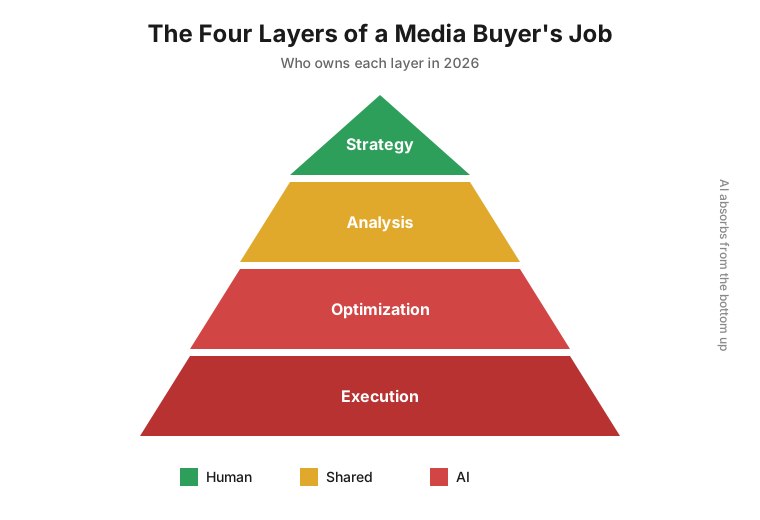
Every media buying role, whether in-house, agency, or freelance, is really four jobs stacked on top of each other. We call this the AdAdvisor Four-Layer Model, and naming the layers separately is the only way to answer the replacement question honestly, because AI is absorbing them from the bottom up, not all at once.
The four layers are execution, optimization, analysis, and strategy. Execution is the mechanical work of building and launching. Optimization is the ongoing adjustment of what is already live. Analysis is making sense of what happened and why. Strategy is deciding what to do in the first place and standing behind it.
The AdAdvisor Four-Layer Model at a glance
Read from the bottom up: Execution and Optimization are AI-owned, Analysis is shared between AI and human, and Strategy is human-owned. AI absorbs the lower, mechanical layers first and stalls at the layers that need judgment and accountability.
The four layers of a media buyer's job vs AI capability today
| Layer | What it means | AI capability today | Why |
|---|---|---|---|
| Execution | Building campaigns, line items, budgets, launching | High | Purely mechanical and rule-based; automation is faster and more consistent than any human |
| Optimization | Budget shifts, bid changes, audience expansion, fatigue detection | Partial to High | Platform AI handles most in-flight adjustment inside set guardrails |
| Analysis | Explaining why results happened, spotting non-obvious patterns | Partial | AI surfaces anomalies fast, but connecting a data shift to a cause needs human context |
| Strategy | Offer, positioning, market selection, defining success, when to override | Low | Requires accountability, taste, and business context AI does not hold |
Analysis sits in the middle for a specific reason worth spelling out. AI identifies patterns; humans explain causes. An agent will flag that cost per acquisition jumped 40% on Tuesday and that a particular audience segment drove it. What it cannot reliably tell you is that the jump happened because a competitor launched a promotion, your landing page broke on mobile, or the segment was never really your buyer.
Our read of this pattern is straightforward, and we state it as analysis rather than settled fact: the lower the layer, the more completely AI takes it. Execution is fast becoming machine work, optimization is heading the same way, analysis stays shared, and strategy is not moving. If that holds, a buyer whose entire value was execution and optimization is genuinely exposed, while a buyer who owns analysis and strategy becomes harder to replace, not easier. The AdAdvisor Four-Layer Model maps directly onto the broader AdAdvisor Advertising Maturity Model, which tracks the four generations of ad automation this shift runs through.
What AI Does Better Than a Human
Being honest about this is what earns trust, so here is our position stated plainly, followed by the reasons behind it. On the bottom two layers, we believe AI is not just cheaper than a human. It is better.
The reasoning is mechanical, not speculative. It monitors continuously. A person checks an account a few times a day; an agent checks every few minutes and never sleeps, so it reacts to a spend spike or a broken conversion event in minutes instead of hours. It applies rules with perfect consistency and no fatigue, so the four-hundredth ad set gets the same discipline as the first. And it acts at a scale no team can match by hand.
Handing everything over and just saying 'go' puts the burden on the brand and the advertiser to make it work. There's a lot of value to be extracted, but that future is much further down the line.
Meta's own numbers point the same way. Meta reports that Advantage+ shopping campaigns deliver a 17% lower cost per purchase than manual campaigns, and a 32% lower cost per incremental conversion when Advantage+ runs alongside manual, based on Meta's reported data.
That figure comes from the platform selling the product, so weigh it accordingly. What Advantage+ does not decide is which creative to feed it, and independent data shows how much that matters: Motion's 2026 analysis of more than 550,000 Meta ads found that only about 6% of ads drive the majority of account spend. Automation scales delivery, but a human still supplies and judges the creative and offer that decide whether the spend works. That gap between the platform's metric and the real business outcome is exactly what a human has to catch.
There is a hard limit here, and it is the expert point most coverage skips. Speed without context compounds mistakes instead of catching them. An agent that reallocates budget every few minutes will pour spend into a winning ad set that happens to be attracting the wrong customers, faster and more thoroughly than a human ever could, because it is optimizing the metric it was given, not the outcome you actually wanted. Automation makes good judgment scale and it makes bad judgment scale. That is exactly why the top layer stays human.
Automation on the execution and optimization layers
Pros
- Reacts in minutes, continuously, with no fatigue
- Applies rules consistently across hundreds of ad sets
- Near-zero marginal cost per change
- Scales execution far beyond any human team
Cons
- No business context; optimizes the metric it was given
- Can scale a flawed objective as efficiently as a good one
- Platform-reported metrics may hide non-incremental revenue
- Cannot be accountable for the outcome
AI vs Manual Media Buying: A Side-by-Side
AI wins on execution speed and consistency; manual buying wins on context and judgment. The point is not that one replaces the other, but that they are good at opposite things.
AI vs manual media buying: where each has the edge
| Dimension | AI / automated buying | Manual / human buying |
|---|---|---|
| Reaction speed | Minutes, continuous, no sleep | Hours, checked a few times a day |
| Consistency at scale | Identical rule discipline across hundreds of ad sets | Degrades with volume and fatigue |
| Cost of execution | Near-zero marginal cost per change | Expensive human hours |
| Business context | None; optimizes the metric it was given | Understands the offer, market, and real goal |
| Objective setting | Cannot decide what to optimize for | Defines what a good result means |
| Accountability | Cannot be held responsible | A person owns the outcome |
| Best used for | Execution and in-flight optimization | Strategy, offer, and override decisions |
The correct 2026 setup is not one or the other. It is automation running the bottom two layers under a human who owns the top two. For the mechanics of that split, see how AI media buying works.
The New Job: What Media Buyers Should Become
The forward path is not to defend execution work that is already lost. It is to become the person who directs the automation rather than competes with it. The agent plays the instruments and the buyer becomes the conductor. The role moves from doing the work to deciding what the work should be and judging whether the machine is doing it right.
This is already visible in how teams staff up. In a five-person agency, campaign setup and daily budget management once took two junior media buyers most of the week. With AI handling those execution tasks, the same team now spends that time on offer testing, creative strategy, and client consulting instead of repetitive account maintenance. The headcount did not vanish; the work moved up the pyramid.
Concretely, that means owning four things automation cannot own. The offer, because no algorithm decides what you sell or why anyone should care. Creative direction, because AI can generate variations but not the strategic idea worth varying. Account structure and guardrails, because someone has to define the objectives, constraints, and success metrics the AI optimizes toward. And the override call, knowing when the data is lying, when a winning metric hides a losing outcome, and when to pull the machine back.
The skills to build follow directly: sharper offer and positioning thinking, real analytical literacy so you can interrogate what the AI reports instead of trusting it, and the operator judgment to set up an AI media buyer correctly and supervise it. This is the model behind AdAdvisor, built by an ex-Meta developer on eight years in paid media and more than $60M in managed ad spend: it is AI that runs the account while the human runs the account strategy. AI runs the account; you run the account strategy.
The Strongest Counterargument
The most serious case against this position is worth stating fairly. Some argue that foundation models are improving so quickly that they will eventually absorb strategic work too, not just execution, and that today's line between the layers is temporary. That is a reasonable long-term possibility, and this article is not claiming strategy is permanently untouchable.
But it does not describe where things stand in 2026. Current systems still depend on humans to define the objective, weigh trade-offs the model cannot see, and accept business responsibility when a campaign fails. A model can propose a strategy; it cannot be accountable for one. Until that changes, the top of the pyramid stays human, and buyers who own it stay valuable.
Frequently Asked Questions
Media buyers and AI: common questions
Mini Summary
AI will not replace media buyers, but it is permanently replacing the execution layer and much of the optimization layer of their work. The AdAdvisor Four-Layer Model, execution, optimization, analysis, and strategy, shows why: AI absorbs the mechanical layers from the bottom up and stalls at the layers that need accountability and judgment. The buyers who win in 2026 direct the automation instead of racing it. To go deeper, see what agentic advertising is and what an AI media buyer actually does.
What Is Agentic Advertising?
The category behind AI agents that plan, buy, and optimize media autonomously.
Read moreWhat Is an AI Media Buyer?
How AI media buyers work and where they fit alongside human strategists.
Read moreSources: Meta Q1 2026 earnings coverage, Meta Advantage+ performance data (Alex Neiman), emarketer FAQ on AI media buying 2026, TensorOps Agentic AI in Advertising 2026 Field Guide.