TL;DR
Facebook ads targeting in 2026 works differently than it did even two years ago. Meta's delivery system now rewards broader targeting paired with strong creative more than the tight interest stacks that used to win. The practical menu comes down to four families: broad plus Advantage+ audience, custom audiences, lookalike audiences, and retargeting. The right choice usually depends on your objective and how much conversion data your account already has. This guide walks through every option and gives you a simple decision aid for picking the right one.
Quick answer
- Broad plus Advantage+ audience likely fits prospecting and scale, especially once the pixel has conversion history to learn from.
- Custom audiences fit re-engaging people who already know you: site visitors, customer lists, and video viewers.
- Lookalike audiences fit finding new people who resemble your best customers, with seed quality mattering more than size.
- Retargeting fits the warm audiences closest to buying, and as a common pattern tends to return some of the strongest ROAS on small budgets.
- Interest and detailed targeting still exist but, for most performance objectives, now act as a suggestion the algorithm can expand past rather than a hard rule.
Facebook ads targeting is the set of controls Meta gives advertisers to decide who sees an ad, spanning demographics, interests, behaviors, your own data, and AI-driven audience discovery. In 2026 the center of gravity has moved from manual audience building toward machine delivery guided by first-party signals.

Drowning in Meta Ads?
Put your campaign on autopilot with Nova.
Read moreWhat targeting options does Facebook Ads have in 2026?
Facebook targeting options in 2026 fall into a few clear families. The manual controls that many advertisers grew up on are still present, but Meta has pruned thousands of granular categories and shifted the system toward automated audience discovery. Meta reported that detailed targeting inputs are now treated as a suggestion for most performance goals rather than a strict boundary the system cannot cross (Meta Business Help Center).
Here is the full menu of facebook audience targeting types and where each one tends to fit.
| Targeting type | What it does | Best-fit objective | Likely avoid when |
|---|---|---|---|
| Broad targeting | Little or no manual audience input; Meta finds buyers using conversion signals | Prospecting and scale on accounts with conversion history | The account is brand new with no conversion history to learn from |
| Advantage+ audience | Meta's AI audience layer; you give optional suggestions, the system expands past them | Most prospecting objectives, now the default for many campaigns | You need strict control for a legally sensitive or highly niche offer |
| Detailed (interest) targeting | Interests, behaviors, and demographics as an audience suggestion | Early testing, niche products, small accounts with little data | The account already has strong conversion volume that broad can use |
| Custom audiences | Reach people from your own data: site visitors, customer lists, engagers | Re-engagement and mid-funnel | Your data source is too small to deliver reliably |
| Lookalike audiences | New people who resemble a source audience you provide | Prospecting when you have a strong seed | Your seed audience is low quality or too small |
| Retargeting audiences | A subset of custom audiences focused on recent intent signals | Warm, high-intent traffic close to purchase | The warm pool is too small, or you have not excluded recent buyers |
| Geographic and demographic | Location, age, gender, language as constraints | Local businesses, age-gated or region-specific offers | Over-tightening a radius and expecting GPS-level precision |
Most of these can be combined. A common structure in 2026 puts the majority of budget behind broad or Advantage+ prospecting, holds a slice back for retargeting, and reserves a smaller test budget for lookalike or interest-seeded ad sets. Treat that split as a starting heuristic rather than a fixed rule, since the right allocation depends on your funnel and your data volume.
The Targeting Ladder: which targeting type for which goal
The Targeting Ladder is a simple decision aid that orders Facebook targeting types from broadest to narrowest and states which rung likely fits which objective and account size in 2026. It is our own framework for thinking about the choice, not an official Meta term. The idea is to start as broad as your data allows and only climb toward narrower targeting when you have a specific reason, because Meta's delivery model generally performs better with more room to find buyers.
| Rung | Targeting type | Likely best for | Account signal needed |
|---|---|---|---|
| 1 (broadest) | Broad plus Advantage+ audience | Scaling prospecting once the pixel has learned | Steady conversion volume |
| 2 | Lookalike audience | Prospecting with a strong customer seed | A quality source audience |
| 3 | Detailed (interest) targeting | Testing angles, niche or new accounts | Little conversion data yet |
| 4 | Custom audience | Re-engaging known visitors and lists | Existing traffic or a customer list |
| 5 (narrowest) | Retargeting | Warm buyers close to converting | Recent site or engagement activity |
Why does the ladder run in this direction? The broader the audience, the more freedom Meta's machine learning delivery has to weigh competing signals and find buyers. As people move closer to a purchase, your own first-party data, site visits, add-to-carts, and past orders, becomes the stronger signal, which is what tends to make narrower types like custom audiences and retargeting more effective at the warm end. Put simply, signal quality usually beats audience restriction.
The ladder is a heuristic, not a guarantee. A brand-new account with no conversion history often has to start higher up the ladder with interest targeting or a lookalike, because broad delivery needs signal to optimize against. A mature account with thousands of monthly conversions can usually sit on rung one and let the system work. For example, an ecommerce account generating well over 10,000 purchases a month usually has enough conversion signal to run broad near rung one, while a local home services business closing only 20 to 30 leads a month often does better combining broader prospecting with carefully built custom audiences and retargeting. The mistake the ladder is designed to prevent is defaulting to narrow targeting out of habit when broader delivery would likely give Meta more room to find profitable buyers.
Broad vs detailed targeting: what changed in 2026?
Broad targeting has moved from a fringe tactic to the default recommendation, and the reason is mechanistic rather than fashion. Meta's ad delivery is a machine learning system that predicts which users are most likely to take your conversion event, then bids for those users in the auction. Every manual constraint you add, a narrow interest, a tight age band, a single behavior, shrinks the pool the model can learn from and can slow how quickly an ad set exits the learning phase.
Two forces pushed this shift. First, Meta removed and consolidated large numbers of detailed targeting options. Starting in January 2022, it removed targeting tied to topics people may perceive as sensitive, such as health causes, sexual orientation, religion, and political affiliation, citing the risk of discriminatory use (Social Media Today). A second round beginning in January 2024 removed or consolidated further categories that Meta described as redundant, too granular, or rarely used, folding specific interests into broader groups. The granular interest stacks that many advertisers relied on are simply not available at the resolution they once were.
Second, signal loss from Apple's App Tracking Transparency and broader privacy changes reduced the third-party data that used to power precise interest targeting. Meta's answer was to lean on its own first-party signals and let AI find patterns across its ecosystem. Advantage+ audience is the product of that shift. You can still hand the system audience suggestions, custom audiences, lookalikes, age, gender, and interests, and it will use those as suggestions, showing ads to people matching that profile and expanding past them when it expects better performance (Meta for Business).
The practical takeaway, hedged appropriately: for accounts with reasonable conversion volume, broad targeting paired with strong creative often outperforms narrow interest targeting now, because it gives the model the freedom it needs. That does not mean interest targeting is dead. It still tends to help early testing, small-budget accounts, and genuinely niche products where the buyer pool is thin and Meta needs a nudge in the right direction.
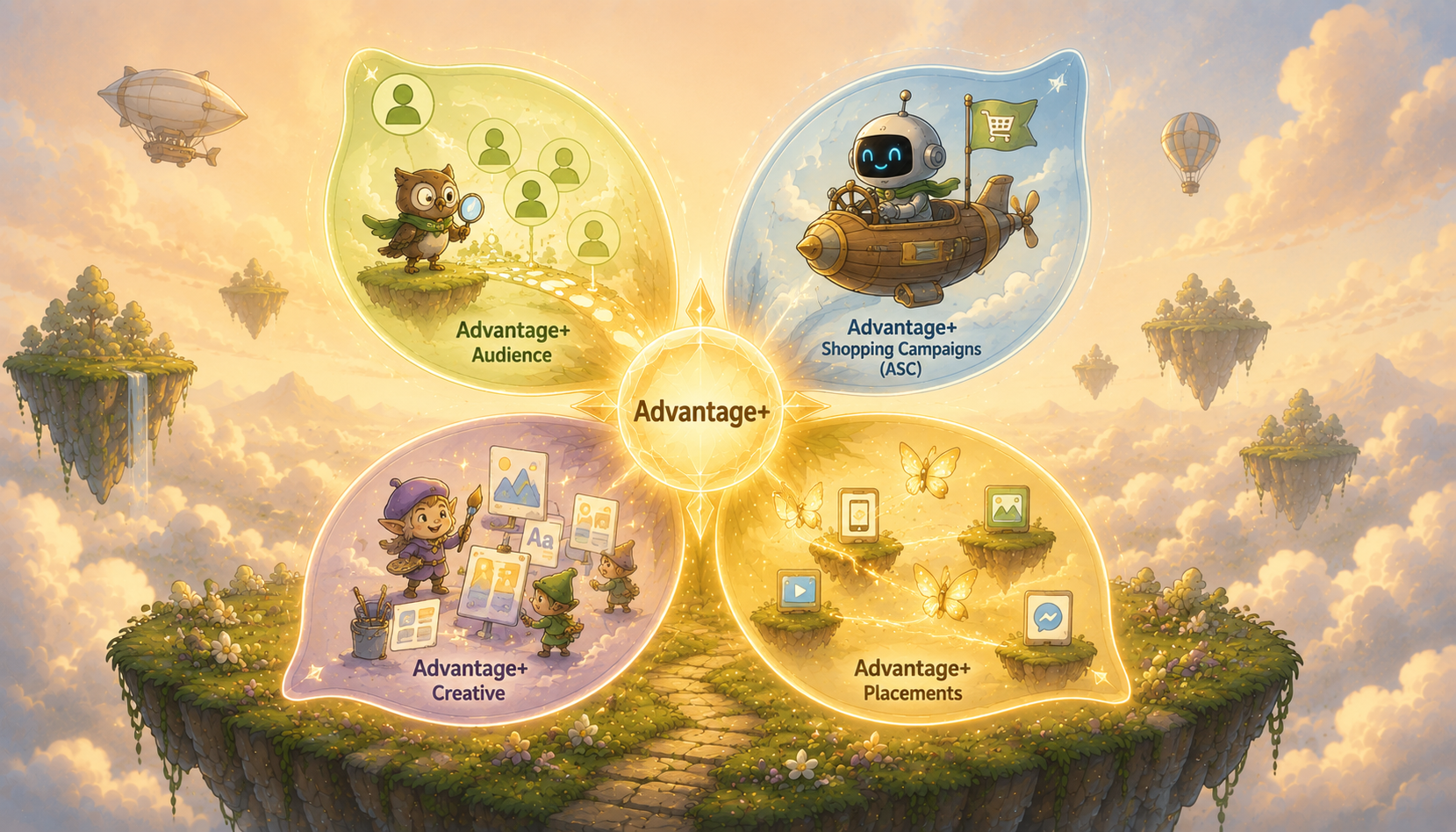
Strategy & Planning
Meta Advantage+: The Complete Guide to All Four Types (And When to Use Each)
Meta Advantage+ in 2026: Advantage+ Sales Campaigns (formerly ASC), plus Advantage+ Audience, Creative, and Placements. What each does and when to use each.
Read moreCustom audiences and geofencing
A facebook custom audience is an audience you build from your own data rather than from Meta's targeting menu. Sources include website visitors captured by the Meta Pixel, customer and email lists you upload, app activity, and engagement with your Facebook or Instagram content such as video views and lead form opens (Meta Business Help Center). Custom audiences are the backbone of mid-funnel and retargeting work, because they let you speak to people who already have some relationship with your brand.
Size matters for delivery. Meta recommends targeting an audience of at least around 1,000 people for reliable delivery, and in practice results tend to be inconsistent well below that. Treat the exact number as a working guideline rather than a hard cutoff, since match rates and delivery behavior vary by source and region. As a concrete example, an ecommerce brand uploading a 5,000-row customer list will often see only a portion match to active Meta accounts, so the delivered audience can land well below the raw list size, which is why leaning on multiple sources such as pixel events plus a customer list usually produces a more reliable pool than any single source alone.
Facebook geofencing, targeting people based on a specific geographic radius, is handled through location targeting rather than a separate product. You can target by country, region, city, ZIP or postal code, or a radius around a pin, and you can layer that on top of any other audience. For a local service business, a tight radius around your service area is often the single most important constraint. For an ecommerce brand shipping nationally, location is usually a light touch used to exclude regions you cannot serve. A common mistake is to set an extremely tight radius on the assumption that Meta behaves like GPS geofencing. In practice Meta's location targeting is probabilistic rather than true GPS-based geofencing, so for footfall-critical campaigns it is worth validating delivery against your own store visit or conversion data rather than assuming pin-level accuracy.
Lookalikes and retargeting
Lookalike audiences and retargeting each deserve their own playbook, so this section is a short overview that hands off to the detailed guides.
A lookalike audience finds new people who share characteristics with a source audience you provide, such as your customer list or your highest-value buyers (Meta Business Help Center). The source needs a minimum of 100 people from a single country, and Meta recommends a source of roughly 1,000 to 5,000 for the model to find meaningful patterns, which most practitioners treat as advisory rather than a hard requirement. In 2026 the lever has shifted from audience size to seed quality, and value-based lookalikes built from your best customers tend to beat generic 1% lookalikes. A dedicated Facebook lookalike audiences guide covers whether lookalikes still work and how to build value-based seeds.
Retargeting, sometimes called remarketing, shows ads to people who already engaged with your brand: site visitors, add-to-carts, video viewers, and past customers. Across many accounts it tends to return some of the strongest ROAS of any targeting type on small budgets, because the audience is already warm, but this is a common pattern rather than a rule, and it only holds when the pool is large enough to deliver and your tracking survives signal loss. A dedicated Facebook retargeting guide covers setup steps, audience sizing, the pixel versus Conversions API question, and the exclusion audiences that stop wasted spend.

Performance Optimization
Facebook Retargeting Ads: How to Set It Up and Make It Work (2026)
How Facebook retargeting works in 2026: audience size floors, pixel plus Conversions API, exclusion audiences that stop wasted spend, and a step-by-step setup.
Read moreHow AI reads audience performance
Choosing the right targeting is only half the job. The harder question is knowing which audiences are actually driving profit rather than just cheap clicks, and that is where reporting usually breaks down. Meta's default columns reward the metrics the platform optimizes toward, which can flatter audiences that generate volume without margin.
This is the gap an AI media buyer is built to close. Connected to your ad account through a tool like the AdAdvisor MCP, an AI layer can likely surface which audiences map to profitable results, flag where a lookalike is quietly overlapping with your retargeting pool, and point out where broad delivery is eating budget on low-value conversions. AdAdvisor brings 8 years in paid ads and more than $60M in managed ad spend to that read, with an ex-Meta developer who built products inside the ads stack shaping how the analysis works. The value is not another dashboard. It is a second set of eyes that connects audience performance back to the numbers that decide whether an account is actually winning.
In practice that read runs as a loop: it ties each audience back to its clicks, then the conversions behind those clicks, then the profit behind those conversions, and turns that into a budget recommendation you can act on before shifting spend. Used this way, AI does not replace the targeting decision. It tends to make the feedback loop faster, so you can move budget toward the audiences likely working and away from the ones that only look good in Meta's default view.
From a recommendation to a change
That loop still ends one step short. It produces a recommendation, and a recommendation is only worth something in the moment somebody acts on it. Audience overlap does not wait for your Thursday review, and a lookalike quietly cannibalizing your retargeting pool costs money on every day between the read and the fix. A faster feedback loop is a real gain, but it still terminates in a person having time that week.
Closing that last step is what Nova is for. Nova is AdAdvisor's AI media buyer for Meta, reading the same audience and creative performance data continuously and then raising the move herself rather than filing it for someone to review. She works from the audience by creative heatmap, deciding which combinations to scale, which to retire, and which to test next, and she judges all of it against your break-even ROAS and margins rather than Meta's default columns. In Suggest mode every proposal waits on your approval before it runs. Once she has earned it, Autopilot lets her execute inside the spend caps, geographies, and exclusions you set, pinging you only when she hits something she cannot decide alone.
Nova is running live accounts today. Access is by application while the founding cohort onboards.
Frequently asked questions
Facebook ads targeting FAQ
Summary
Facebook ads targeting in 2026 rewards a different instinct than it used to. The winning move is generally to start broad, give Meta's delivery model room to find buyers, and only climb toward narrower targeting when your data or your objective calls for it. The four families that matter are broad plus Advantage+ audience, custom audiences, lookalikes, and retargeting, and the Targeting Ladder is a quick way to decide which rung fits your account today. Interest targeting still has a place for testing and niche products, but it now guides delivery rather than fencing it in. Above all, choose targeting by objective and account signal, then judge each audience by whether it drives profit rather than by whether it looks efficient in Meta's default columns. The bigger shift is this: modern Facebook targeting is less about finding the perfect audience by hand and more about giving Meta enough high-quality signals to find that audience for you. Advertisers who internalize that usually spend less time building audiences and more time improving creative and conversion quality.
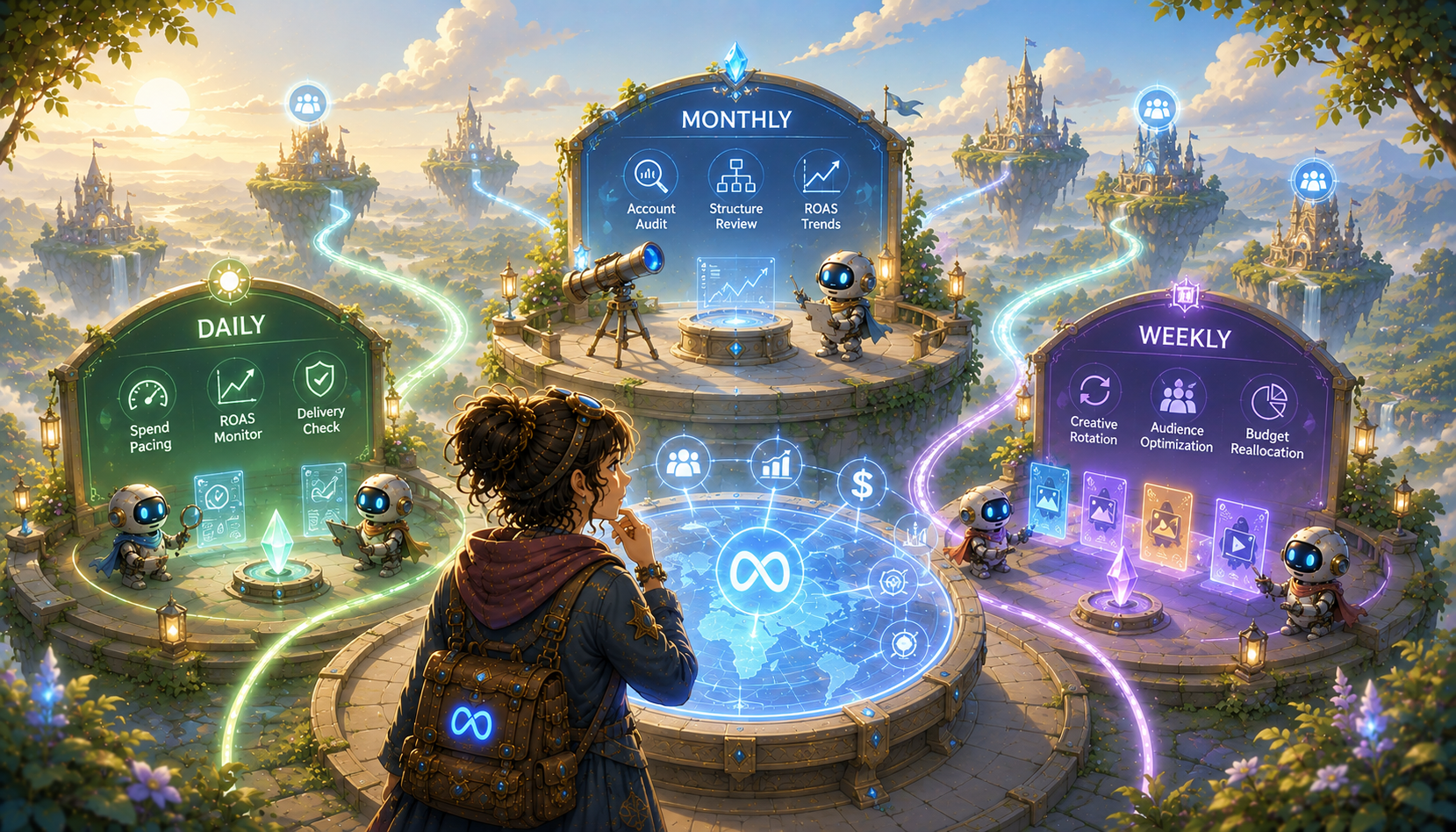
Performance Optimization
Facebook Ads Management: The Complete 2026 Guide
Facebook ads management is the ongoing process of monitoring, optimizing, and scaling paid campaigns in Meta Ads Manager. It involves setting and pacing budgets, tracking ROAS, rotating creatives, managing audiences, and adjusting bids, following a structured daily, weekly, and monthly cadence.
Read more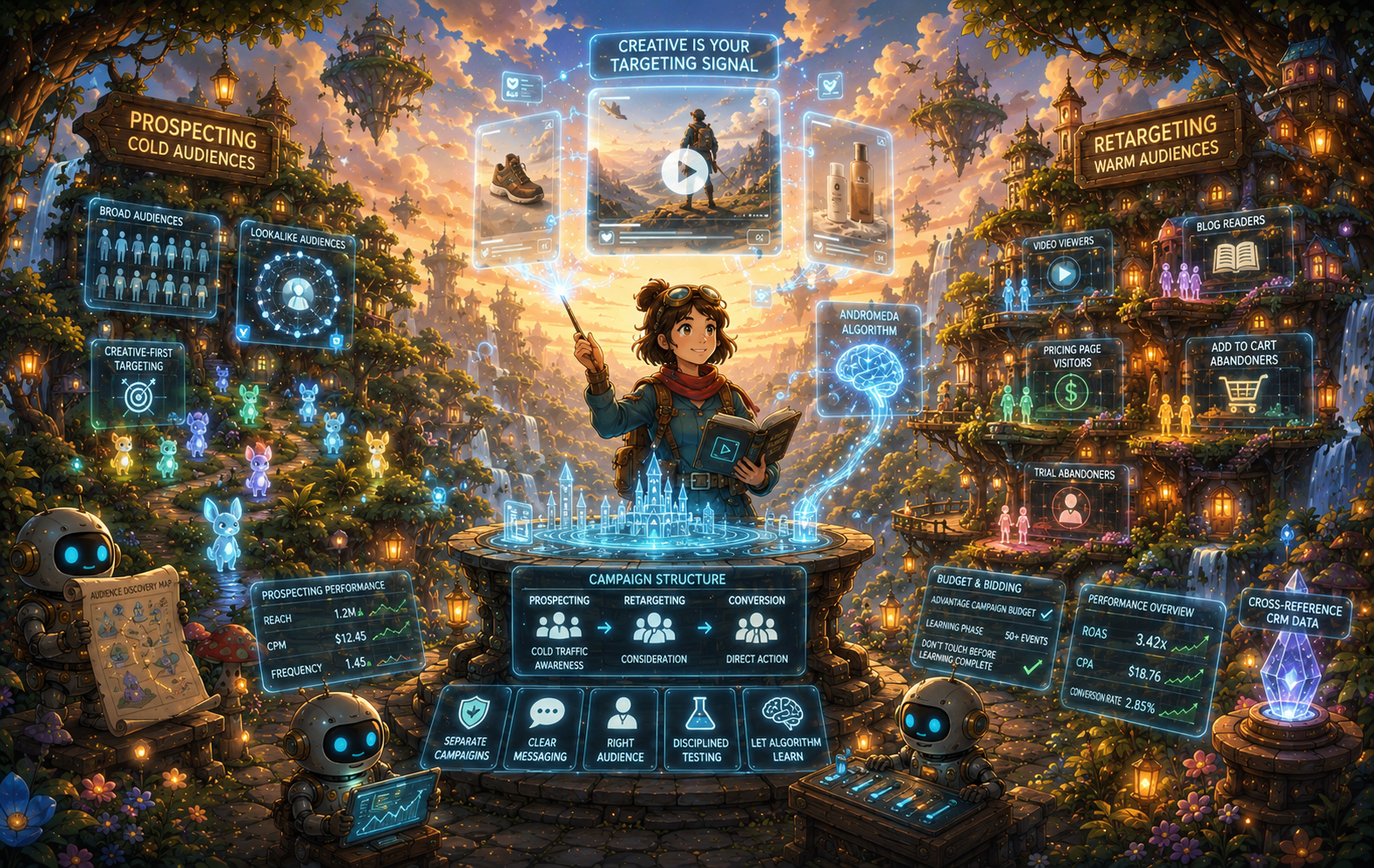
Performance Optimization
Facebook Ads Best Practices: The 2026 Expert Playbook
The best practices for Facebook ads in 2026 come down to three shifts: let creative do the targeting work (Meta's Andromeda algorithm reads your ad to find the right audience), build separate campaigns for cold versus warm traffic, and stop resetting the learning phase with premature changes. The fundamentals (specific creative, segmented retargeting, disciplined testing) haven't changed. How the algorithm uses them has.
Read moreSources
- About Advantage+ Detailed Targeting, Meta Business Help Center
- Advantage+ Audience, Meta for Business
- About custom audiences, Meta Business Help Center
- About how lookalike audiences work, Meta Business Help Center
- Meta to remove more detailed targeting options, Social Media Today
- A guide to Meta Ads targeting in 2026, Jon Loomer Digital